
Zero-Days Don’t Wait for Your Patch Cycle: What the Citrix NetScaler Attacks Reveal About 2026 Exposure Management

A monthly vulnerability scan is not a defense against an attacker who weaponizes a zero-day in days.
The September 2026 exploitation of two Citrix NetScaler ADC and Gateway vulnerabilities: CVE-2026-88771 and CVE-2026-88772-makes that reality impossible to ignore. CISA added both vulnerabilities to its Known Exploited Vulnerabilities catalog, and federal agencies received a September 30, 2026 remediation deadline.
The same period brought additional KEV activity involving WSO2 API Manager, Adobe Commerce, Microsoft SharePoint, and MikroTik RouterOS.
This is not a reason to panic. It is a reason to change how we manage exposure.
The old model: scan once a month, issue a report, patch during the next maintenance window, is no longer fast enough for internet-facing infrastructure. Attackers are moving from disclosure to exploitation with a shrinking time advantage.
Your vulnerability management program must move faster.
THE PATCH WINDOW IS NOW AN ATTACK WINDOW
CVE-2026-88771 was reported as an unauthenticated remote-code-execution vulnerability affecting Citrix NetScaler ADC and Gateway deployments, including default configurations. CVE-2026-88772 was also associated with remote code execution or denial of service and required particular attention for deployments with DTLS enabled.
Both vulnerabilities received critical severity ratings and were under active exploitation.
The risk is not limited to organizations that use unusual configurations or experimental features. NetScaler appliances frequently sit at the edge of the environment: handling remote access, VPN connectivity, application delivery, and traffic management.
That position makes them valuable to attackers.
When a vulnerability affects a device exposed directly to the internet, the sequence can move quickly:
- A vulnerability is disclosed or discovered.
- Attackers analyze the affected product.
- Exploit code is developed or adapted.
- Internet-wide scanning begins.
- Compromised appliances become footholds into business environments.
A quarterly patch cycle assumes the organization has time to schedule, test, approve, and deploy an update. A zero-day attacker does not wait for your change advisory board.
WHY INTERNET-FACING APPLIANCES ARE FAVORITE TARGETS

VPN gateways, application delivery controllers, load balancers, firewalls, and remote access appliances are attractive targets for several reasons.
THEY ARE REACHABLE
An internet-facing appliance is designed to accept connections from outside the organization. That is its purpose, but it also means attackers can test it without first compromising an endpoint or stealing employee credentials.
THEY ARE PRIVILEGED
These systems often control access to internal applications, remote users, administrative interfaces, and sensitive traffic flows. A compromised gateway may provide visibility or access far beyond a single workstation.
THEY ARE OFTEN OVERLOOKED
Security teams commonly focus on laptops, servers, cloud workloads, and identity systems. Network appliances may be managed by a separate infrastructure team, hosted by a third party, or missing from the organization’s central asset inventory.
An appliance that was deployed years ago can remain operational long after the person who installed it has moved on.
THEY CAN BE HARD TO PATCH
Updating an edge device may affect remote access, application availability, authentication, and business continuity. Organizations may delay action because they need a maintenance window, or because they are not certain which systems are exposed.
That uncertainty is itself a risk.
EXPOSURE MANAGEMENT IS NOT THE SAME AS PATCH MANAGEMENT
Patch management asks:
> Which updates are available, and when can we install them?
Exposure management asks:
> Which assets are reachable, exploitable, business-critical, and currently creating unacceptable risk?
Patch management is one part of exposure management. It does not provide the complete picture.
A vulnerability scanner may identify a high-severity finding on an isolated test server and a medium-severity finding on an internet-facing VPN appliance. A CVSS-only process may prioritize the first finding because its score is higher.
A risk-based exposure management process may prioritize the gateway instead because:
- It is directly accessible from the internet.
- Exploitation is confirmed or highly probable.
- It provides a path to internal systems.
- It supports critical business operations.
- It has limited compensating controls.
- It is connected to sensitive applications or identity services.
The question is not simply whether a vulnerability exists. The question is whether that vulnerability creates a credible path to business impact.
Cenova Cyber’s Vulnerability Management as a Service is designed around that distinction. The goal is not to produce another long spreadsheet. The goal is to identify what matters, prioritize it, coordinate remediation, and verify that the risk has actually been reduced.
WHAT CONTINUOUS VULNERABILITY MANAGEMENT LOOKS LIKE
Continuous does not necessarily mean every asset is scanned every minute. It means the process is active, risk-based, and responsive to changes in the environment and threat landscape.
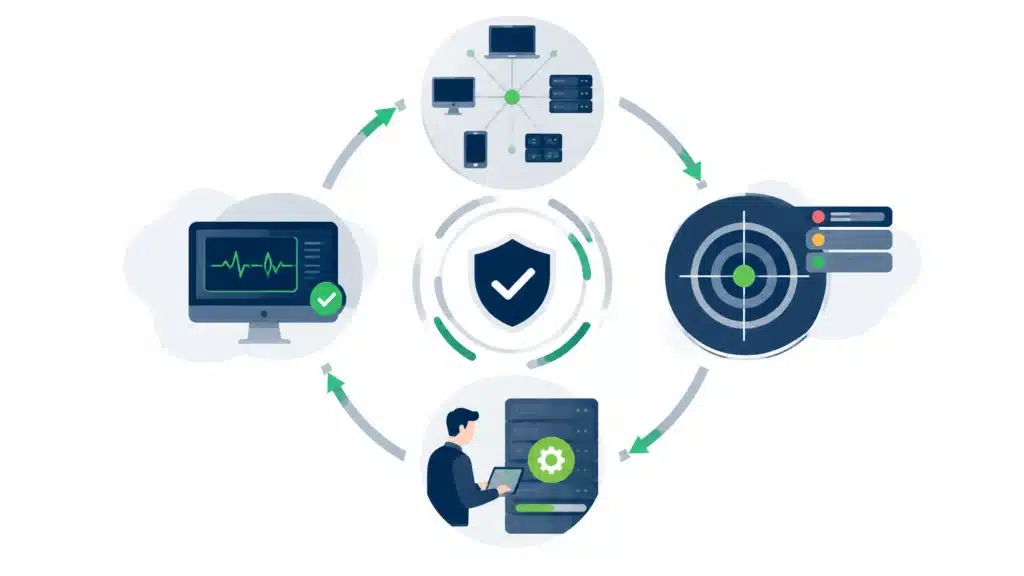
A practical program includes five connected capabilities.
1. MAINTAIN A COMPLETE ASSET INVENTORY
We cannot protect what we cannot see.
The inventory should include:
- Internet-facing appliances
- VPN and remote access systems
- Firewalls and load balancers
- Servers and endpoints
- Cloud workloads
- Active Directory
- Web applications and APIs
- Shadow IT and unmanaged devices
- Test, backup, and disaster recovery systems
The Citrix incident reinforces why edge infrastructure deserves special attention. A forgotten or incorrectly inventoried appliance can remain exposed while the rest of the organization believes its patch program is working.
2. MONITOR FOR NEW EXPOSURES
New assets appear. Configurations change. Vendors release advisories. Vulnerabilities move from theoretical to actively exploited.
Continuous monitoring combines recurring internal and external scanning with current vulnerability intelligence. It should also identify whether a newly disclosed vulnerability affects an asset the organization owns.
This is where KEV information matters. A vulnerability confirmed in active exploitation should immediately receive a different priority from a vulnerability that has no known exploitation and affects a low-value internal system.
3. PRIORITIZE BY REAL-WORLD RISK
A useful priority model considers more than severity.
We evaluate:
- Exploit availability
- Active exploitation
- Internet exposure
- Asset criticality
- Data sensitivity
- Privilege and access pathways
- Existing security controls
- Business and compliance requirements
- Availability of a vendor fix or mitigation
This approach gives leadership a defensible answer to a difficult question: What must we fix first?
4. COORDINATE REMEDIATION
Finding a vulnerability is not the same as fixing it.
Remediation may require infrastructure, application, security, compliance, and business teams to coordinate. For an exposed NetScaler appliance, the response may include applying the fixed build, reviewing configurations, restricting access temporarily, disabling a vulnerable feature where appropriate, and checking for evidence of compromise.
A strong program tracks each action to completion. It assigns ownership, records deadlines, documents exceptions, and escalates overdue work.
5. VALIDATE THE RESULT
A patch report is not proof that exposure is gone.
After remediation, the organization should validate:
- The correct asset was updated.
- The correct version is running.
- The vulnerable condition is no longer present.
- External exposure has been reduced as intended.
- Compensating controls are still operating.
- No signs of compromise were missed.
Cenova Cyber combines vulnerability discovery, risk-based prioritization, remediation coordination, and validation reporting so your team can move from finding to resolution.
PATCHING IS ONLY HALF THE NETSCALER RESPONSE
For actively exploited internet-facing appliances, applying the vendor update is essential. It is not always sufficient.
Organizations should also confirm that they have identified every affected instance, including secondary, disaster recovery, lab, and test environments. They should review authentication events, administrative activity, configuration changes, system logs, and other available forensic artifacts.
If patching cannot be completed immediately, temporary risk-reduction measures may include restricting internet access, placing additional controls in front of the appliance, or disabling an exposed feature when operationally feasible.
The exact response depends on the environment. But the principle is consistent:
Patch the vulnerability. Investigate the exposure. Validate the outcome. Monitor for recurrence.
THE ROLE OF A 24/7 SOC
Exposure management identifies where risk exists. A 24/7 Security Operations Center helps determine whether someone is actively taking advantage of it.
Continuous monitoring can provide visibility into:
- Suspicious authentication activity
- Unusual administrative access
- Unexpected configuration changes
- Malicious network behavior
- Signs of command execution
- Attempts to move from edge infrastructure into internal systems
That combination matters. Vulnerability management reduces opportunities for compromise. Security monitoring helps detect attacks that are already underway or attempts to exploit weaknesses before remediation is complete.
Together, they create a stronger operating model than either service provides alone.
BUILD A PROGRAM THAT MOVES AT ATTACKER SPEED
The Citrix NetScaler attacks are not just another patching story. They demonstrate that exposure can become urgent before a normal maintenance cycle begins.
Monthly scanning and quarterly patching may still have a role for lower-risk systems. They cannot be the entire strategy for internet-facing, business-critical infrastructure.
Your organization needs to know:
- What is exposed to the internet?
- Which vulnerabilities are actively exploited?
- Which assets create the greatest business risk?
- Who owns remediation?
- How quickly can emergency changes be made?
- How do you prove the risk was addressed?
- Are you watching for signs of compromise while remediation is underway?
Cenova Cyber helps answer those questions through VMaaS and 24/7 security monitoring. We deliver continuous discovery, risk-based prioritization, guided remediation, validation, and compliance-ready reporting, so your team can focus on the business instead of chasing vulnerability spreadsheets.

GET A CLEAR VIEW OF YOUR EXPOSURE
Do not wait for the next zero-day to reveal what your patch process missed.
Schedule a free vulnerability assessment with Cenova Cyber. We will help you identify exposed assets, understand which vulnerabilities matter most, and build a practical path toward continuous risk reduction.
Contact Cenova Cyber today and find out where your environment stands before attackers do.