
The #1 Breach Vector Just Changed for the First Time in 19 Years: Vulnerability Exploitation Overtook Stolen Credentials

For the first time in the 19-year history of Verizon’s Data Breach Investigations Report, vulnerability exploitation has overtaken credential abuse as the leading initial-access vector. In the 2026 DBIR, exploitation accounted for 31% of breaches, compared with 13% for credential abuse.
That is a significant shift in where attackers are getting in, and a warning for organizations that still treat vulnerability management as a quarterly scan followed by a spreadsheet.
The message isn’t that phishing and stolen credentials no longer matter. It’s that attackers adapt. As organizations improve identity controls and detection, adversaries look for paths that remain exposed: unpatched systems, misconfigurations, and assets no one realized were still connected. The DBIR data shows the shift in breach patterns; it does not, by itself, prove what caused the change.
For business leaders, the practical question is clear: Can your team identify which vulnerabilities put your most important systems at risk, and verify they’ve been fixed?
WHAT THE DBIR FINDING TELLS US
Verizon’s 2026 DBIR analyzed more than 31,000 security incidents, including more than 22,000 confirmed breaches, with contributions from organizations around the world. Its vulnerability analysis draws on scanner data from more than 13,000 organizations. The report describes exploitation as the leading initial-access vector for the first time in its history.
The report’s remediation findings add urgency:
- Only 26% of observed critical vulnerabilities listed in CISA’s Known Exploited Vulnerabilities (KEV) catalog were fully remediated during 2025.
- The median time to full remediation rose to 43 days, up from 32 days in the prior reporting period.
These figures are not a census of every organization or every vulnerability. Verizon’s KEV analysis reflects vulnerabilities its contributing organizations detected with scanners and their observed remediation status. That scope matters, but the findings still point to a persistent operational challenge: known-exploited vulnerabilities can remain open for weeks.
See the 2026 Verizon DBIR for the report’s findings and methodology, and the CISA KEV Catalog for vulnerabilities confirmed as exploited in the wild.
THE THREAT MODEL HAS CHANGED
Organizations have invested in email security, multifactor authentication, identity monitoring, and user awareness. Those controls remain essential. But a security program cannot assume attackers will keep choosing the same route into a network.
Exploiting a vulnerability can let an attacker bypass a well-trained employee entirely. A vulnerable internet-facing application, an overlooked appliance, or an unpatched server may provide access without a convincing phishing message or a compromised password.
The vulnerability may be old. The asset may be outside the team’s regular inventory. Or the patch may be available, but remediation has stalled because no one has assessed the system’s business importance or coordinated the work.

That is why exposure management must start with what is actually in your environment. A vulnerability’s significance depends on more than its severity score. Is the affected system reachable from the internet? Does it support a critical business process? Is there evidence of active exploitation? Are compensating controls in place? Can the team safely patch it, and confirm the issue is closed?
The shift is not a reason to abandon identity security. It is a reason to treat vulnerability management as a core part of breach prevention, alongside identity, endpoint, email, and network defenses.
WHY “SCAN, REPORT, REPEAT” FALLS SHORT
A scan can identify weaknesses. It cannot, on its own, ensure your organization fixes the ones that matter most.
Traditional scan-and-report programs often struggle in four ways:
- Quarterly snapshots leave long gaps. New assets and vulnerabilities can appear between scans. A report describes what the scanner saw at a point in time, not necessarily what is exposed today.
- CVSS alone doesn’t give enough context. A severity score is useful, but it does not tell you whether a vulnerability is actively exploited, internet-facing, or present on a business-critical system.
- Incomplete asset inventories hide exposure. Unmanaged devices, cloud workloads, and forgotten systems can fall outside the scanning program.
- Findings don’t equal remediation. A report is not a patch. Without owners, ticket tracking, follow-up, and validation scans, a finding can remain open long after it has been identified.
The result is a familiar cycle: teams face a long list of findings, struggle to determine what to address first, and spend valuable time chasing updates. The highest-risk exposure can stay unresolved while the team works through a list ranked by severity alone.
Effective vulnerability management connects discovery to action. It brings asset context and exploit information into prioritization, coordinates remediation with the people who manage the systems, and checks that the fix worked.
MAKE PRIORITIZATION PRACTICAL
The goal isn’t to patch everything at once. It’s to reduce the exposures most likely to create business harm, in a sequence your team can manage.
A practical process should:
- Maintain an accurate asset inventory. Include endpoints, servers, cloud workloads, internet-facing systems, and other assets that could expose the organization.
- Identify vulnerabilities regularly. Use a scanning cadence suited to the environment, with particular attention to critical and externally exposed assets.
- Prioritize with context. Consider known exploitation, asset criticality, exposure, and business impact, not CVSS in isolation.
- Assign and track remediation. Make ownership and next steps clear, coordinate with IT and system owners, and track work through resolution.
- Validate the result. Re-scan or otherwise verify the vulnerability is closed, and retain clear records of remediation.
This is how organizations turn vulnerability findings into a repeatable risk-reduction program. It also helps leaders see what is being addressed, what remains open, and where support or decisions are needed.
HOW CENOVA CYBER’S VMAAS HELPS CLOSE THE GAP
Vulnerability Management as a Service (VMaaS) from Cenova Cyber helps organizations move beyond scan-and-report workflows. Our service combines asset discovery, recurring internal and external scanning, risk-based prioritization, guided remediation, and validation, so your team can focus attention on the exposures that matter most.
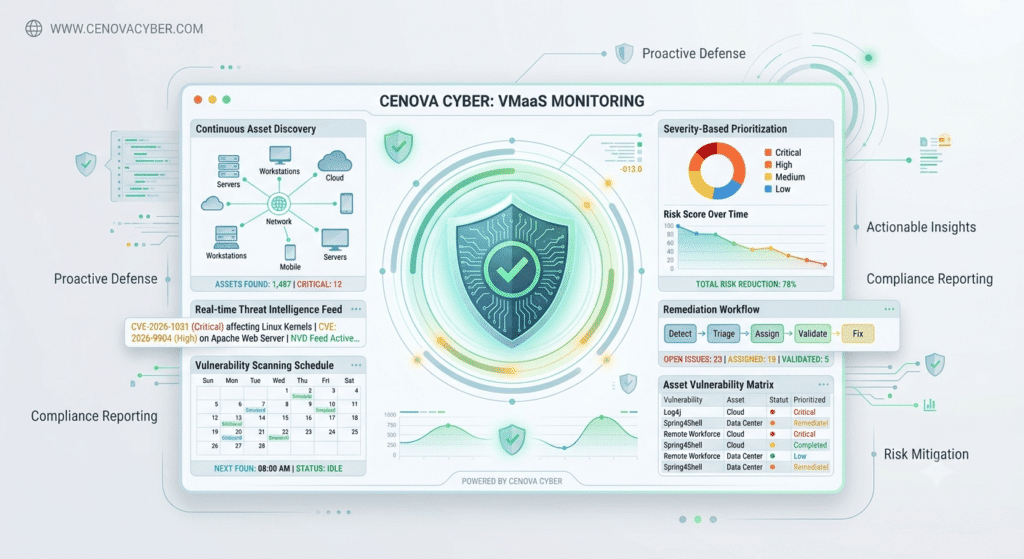
Our VMaaS approach includes:
- Asset discovery and baseline inventory to identify endpoints, servers, cloud workloads, and internet-facing assets.
- Risk-based prioritization that adds exploit information and asset context to vulnerability findings.
- Guided remediation to coordinate patching and track work through resolution.
- Validation and reporting to confirm closure and give teams and leaders a clearer view of exposure.
Cenova Cyber’s VMaaS is designed to extend your team’s capacity, not replace it. We work with your staff to turn findings into clear, trackable actions. Learn more about Cenova Cyber Vulnerability Management as a Service.

A MILESTONE, AND A CALL TO ACT
The change in Verizon’s 2026 DBIR is more than a headline. It highlights a challenge security teams already face: attackers can take advantage of vulnerabilities that are known, detectable, and still waiting for remediation.
A vulnerability program that ends with a scan report leaves too much work, and too much risk, on your team’s desk. Knowing what you own, prioritizing what matters, coordinating the fix, and verifying closure turn vulnerability management into a practical defense.
Request a free vulnerability exposure assessment from Cenova Cyber. We’ll help you identify where exposure may exist and discuss clear next steps for reducing risk. Explore VMaaS and book a free consultation.