
Free Software Isn’t Free Operations: The Honest Build-vs-Managed Math for Open-Source SIEM

Wazuh removes a significant line item from your security budget: the software license. Its self-hosted platform is free and open source, with no per-agent license fee. But the platform still needs infrastructure, engineering, detection tuning, maintenance, and people who can respond when the alerts matter.
That is the real build-vs-managed question. Not “Is Wazuh free?” but “Who will operate it, and what will that work cost over time?”
START WITH THE COSTS THAT DON’T DISAPPEAR
A self-hosted Wazuh deployment needs compute and storage for its server, indexer, and dashboard. It also needs someone to deploy and secure those components, bring in relevant log sources, tune rules, manage upgrades and backups, and maintain the system as your environment changes.
The workload depends on your setup. Wazuh’s quickstart guidance says an all-in-one deployment is usually sufficient for up to 100 endpoints and 90 days of indexed alert data. Larger environments may need a distributed deployment. Actual storage needs depend on event volume and retention, not endpoint count alone.
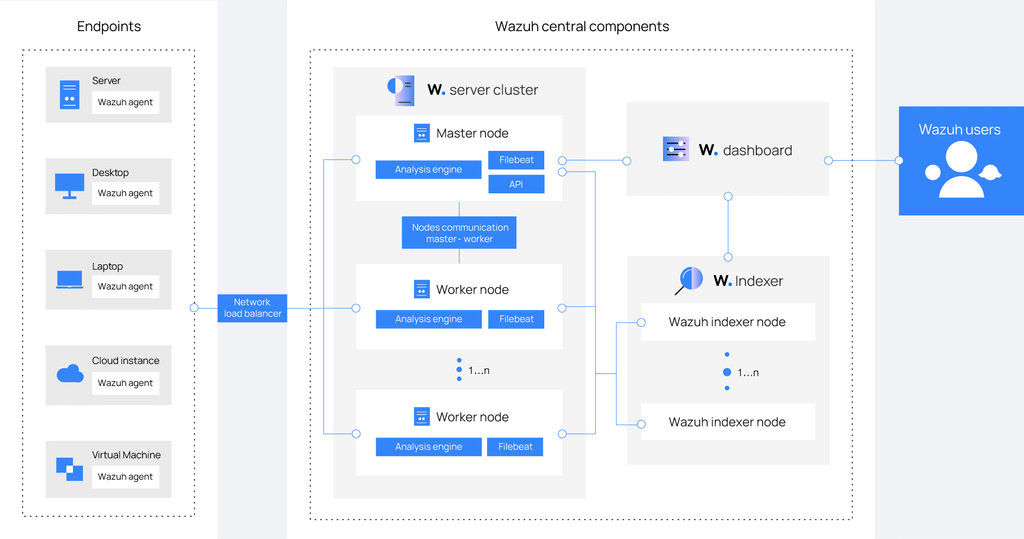
Infrastructure is only part of the bill. Include the hours your team spends on:
- Deployment and integration: connecting endpoints, cloud services, identity systems, and network devices.
- Detection tuning, reducing low-value alerts while preserving meaningful coverage.
- Platform upkeep: patching, upgrades, backups, and cluster health.
- Security operations: reviewing alerts, investigating incidents, and escalating or responding at the right time.
A spreadsheet that counts servers but assigns no value to staff time is not a total-cost estimate. It is an incomplete one.
WHAT THE 2026 TCO COMPARISONS CAN, AND CAN’T, TELL YOU
Some 2026 third-party comparisons suggest that self-hosted Wazuh can have a three-year total cost of ownership around one-fifth to one-eighth that of established commercial SIEMs in certain mid-market scenarios. Those estimates are worth examining, but they are not a guarantee or a universal benchmark.
For example, a 2026 comparison from HostSpezial estimates three-year Wazuh costs of roughly €60,000–€95,000 against €330,000–€490,000 for Splunk in a typical 50–200-employee environment. Its midpoint figures put Wazuh at about one-fifth of the Splunk estimate.
The limitation matters: this is a third-party planning estimate, not an audited or controlled study. The published ranges do not establish a consistent one-fifth-to-one-eighth outcome across organizations, and the comparison says one-time project costs are excluded. Team capabilities, log volume, retention, availability requirements, and the scope of included operations can all change the result.
So treat the ratio as a scenario to investigate, not a promise to build a budget around. Ask what the comparison includes, what it excludes, and whether its assumptions match your environment. A useful estimate should compare equivalent coverage and account for people, infrastructure, retention, resilience, and response.
Commercial SIEMs can shift much of the platform burden to a subscription, but often charge according to data ingestion or other usage measures. That can simplify operations while making volume, retention, and service scope important cost drivers. Compare full operating models, not just the license line against the cloud bill.
CHOOSE THE OPERATING MODEL THAT FITS YOUR TEAM

Self-host Wazuh when you have the people and the platform experience. Organizations with existing DevOps or platform engineering capability may be able to run Wazuh at lower cost and retain more control over deployment, data, and detection content. The key is having a named owner with protected time, not assuming someone will handle it between other priorities.
Choose a commercial SIEM when its operating model fits your needs. A subscription can move some infrastructure and platform work to the vendor. Make sure you understand how ingestion, retention, support, and service scope are priced, and whether your team still owns alert investigation and response.
Consider a managed Wazuh model when you want the platform without building the operating function. Hosted infrastructure alone is not the same as security operations: a service can manage the central platform while leaving your organization responsible for tuning, monitoring, investigation, and response. Confirm precisely what the provider takes on.
For lean IT teams, the risk in self-hosting is often not that Wazuh fails to install. It is that ongoing work has no owner. Tuning slips. Maintenance gets deferred. Alerts pile up without timely review. The organization owns a SIEM deployment, but not necessarily a dependable monitoring capability.
THE MANAGED MIDDLE PATH
A managed model can preserve Wazuh’s cost and flexibility benefits while providing the operational expertise needed to keep the platform useful. Cenova Cyber provides managed security monitoring built on Wazuh: we run the deployment, tune detections, maintain the cluster, and provide 24/7 analyst review. That gives your organization SIEM coverage without hiring a platform engineer and a night-shift analyst to operate it internally.
Our security monitoring service combines Wazuh SIEM with monitoring, alert investigation, and analyst-led security operations. The goal is not to hand you another dashboard. It is to help turn security data into prioritized, actionable findings, so your team can focus on running the business.
A managed service is not automatically the right choice. If your team already operates a mature platform and has a staffed security function, self-hosting may be the better fit. If it doesn’t, be honest about the cost and time required to create that capability.
QUESTIONS TO ASK ANY PROVIDER, INCLUDING US
Before you sign an agreement, get clear answers to these operational questions:
- Who owns tuning when alert volume spikes? Ask who investigates the cause, adjusts detections, and verifies that useful signals are not being lost.
- What infrastructure redundancy backs the stack? Understand the resilience and recovery arrangements, and which components or responsibilities remain yours.
- What happens during an indexer failure? Ask how the issue is detected, how data continuity is handled, and how service is restored.
- How is detection content kept current? Find out who reviews changes, tests updates, and adapts coverage to new threats and changes in your environment.
- Who investigates and responds to an alert after hours? Confirm analyst coverage, escalation paths, and the actions the provider is authorized to take.
- What are the service boundaries? Separate platform maintenance from security monitoring and incident response; ask which tasks are included and which are not.
The answers should be specific enough that you can explain who is responsible during a real incident. A provider’s name on a contract does not make every operational responsibility theirs.
MAKE THE DECISION WITH THE FULL MATH
Use this as a practical three-year comparison:
- Self-hosted Wazuh: infrastructure + implementation + engineering and tuning time + maintenance + alert review and response.
- Commercial SIEM: subscription and usage charges + any retained engineering, monitoring, and response work.
- Managed Wazuh: service and infrastructure costs + any responsibilities, integrations, or response activities that remain in-house.
Then test the numbers against your actual event volume, retention needs, availability requirements, and staff capacity. A deployment is only economical if your organization can operate it consistently.
If you’re weighing Wazuh against a commercial SIEM, or wondering whether your current team can own the ongoing workload, schedule a free consultation with Cenova Cyber. We’ll help you assess the operational requirements and identify a model that fits your environment.