
The Audit-Evidence Machine: How Wazuh Turns Daily Log Review Into HIPAA, PCI, and GDPR Reporting

For many healthcare organizations, the hard part of an audit is not that no security work has happened. It is proving what happened, when it happened, what the team found, and how it was addressed.
Wazuh can help turn daily security activity into organized, control-oriented evidence. Its dashboards and rule mappings connect security events to frameworks such as HIPAA, PCI DSS, and GDPR. Its Security Configuration Assessment (SCA) module can also identify configuration weaknesses across monitored systems.
The important distinction: Wazuh supports compliance evidence; it does not make an organization compliant. The platform can help collect and organize technical artifacts. Your policies, risk analysis, assigned responsibilities, and business processes still have to be in place.
HIPAA NEEDS MORE THAN A YEAR-END EVIDENCE SCRAMBLE
The HIPAA Security Rule calls for both a meaningful risk analysis and regular review of information-system activity. Under 45 CFR § 164.308(a)(1), the required specifications include risk analysis and procedures to regularly review records such as audit logs, access reports, and security incident tracking reports. 45 CFR § 164.312(b) also requires audit controls that record and examine activity in systems containing or using electronic protected health information (ePHI).
That work should be part of ongoing risk management, not something reconstructed from memory when an auditor or the Office for Civil Rights (OCR) asks for documentation. As we emphasize in our HIPAA compliance guidance, monitoring and evidence support a broader program; they do not replace the organization’s risk analysis or security responsibilities.
Wazuh helps operationalize parts of that work by collecting and analyzing system activity, surfacing alerts, and presenting related events in a HIPAA-focused dashboard.
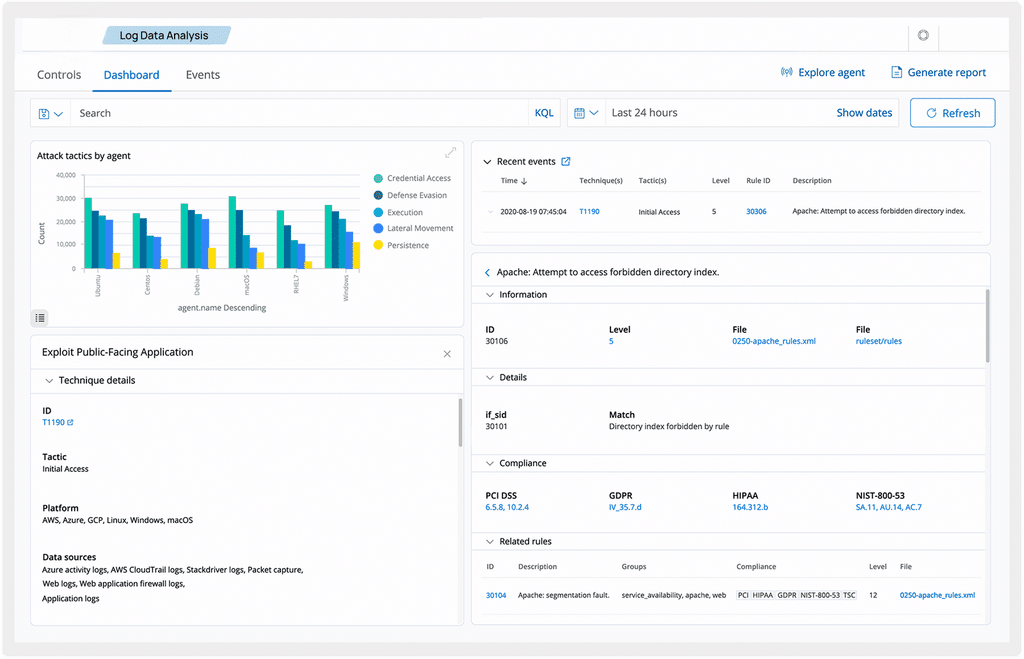
HOW WAZUH CONNECTS EVENTS TO FRAMEWORKS
Wazuh’s default ruleset includes mappings for PCI DSS, HIPAA, GDPR, NIST 800-53, and other frameworks. In practical terms, relevant alerts can be associated with control identifiers, helping teams investigate activity in the context of a requirement rather than treating every event as an isolated technical signal.
The Wazuh dashboard includes regulatory compliance views for reviewing mapped alerts and events. Teams can filter and investigate activity, and the platform supports report generation. This creates a useful starting point for evidence such as:
- Security alerts and related event details
- Audit activity from monitored endpoints and services
- File-integrity monitoring events
- Security configuration assessment results
- Cloud infrastructure activity collected through integrations
The mapping is a navigation aid, not an assessor’s conclusion. Wazuh’s regulatory compliance documentation explicitly notes that mappings are indicative and do not certify or guarantee compliance. The organization must determine which requirements apply, confirm that the right sources are monitored, investigate findings, and retain evidence appropriate to its program.
HIPAA: SUPPORTING REGULAR ACTIVITY REVIEW
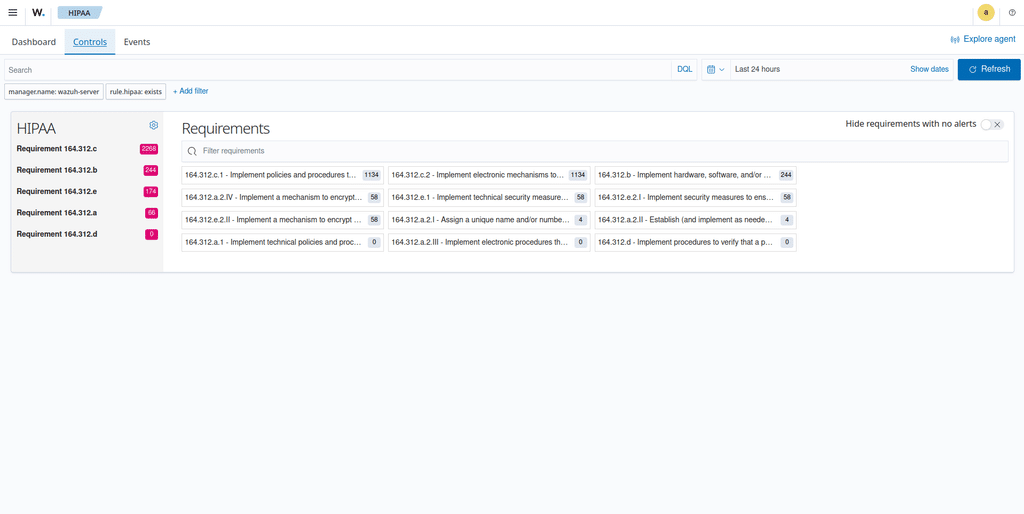
Wazuh’s HIPAA dashboard groups relevant events by HIPAA section and provides context about the controls. The dashboard can help teams review alerts and activity associated with information-system activity review under § 164.308(a)(1). It does not decide whether your organization’s review procedures are adequate; that depends on your policies, scope, review frequency, assigned roles, and documented follow-up.
See Wazuh’s HIPAA dashboard documentation for details about its views and event review features.
PCI DSS AND GDPR: RELATED EVIDENCE, DIFFERENT OBLIGATIONS
For PCI DSS, Wazuh provides a dashboard for monitoring events related to requirements, including Requirement 10’s focus on logging and monitoring access to system components and cardholder data. The PCI DSS dashboard documentation describes reviewing alerts and configuration assessment results as part of that picture. Applicability and sufficiency still need to be assessed against the organization’s actual cardholder data environment and PCI DSS obligations.
For GDPR, Wazuh’s rules and dashboards can help identify and review events relevant to security controls. For example, file-integrity monitoring can provide evidence of changes to monitored files. That evidence may inform security oversight, but it does not, by itself, demonstrate that an organization has met GDPR’s broader legal, privacy, and organizational obligations.
USE SCA TO MAKE CONFIGURATION DRIFT VISIBLE
Security policies can be well written while systems quietly drift away from their intended configuration. An old service remains enabled. A setting changes during troubleshooting and is never restored. A new server is deployed without the expected hardening baseline.
Wazuh’s Security Configuration Assessment module checks monitored endpoints against policy files. Wazuh includes out-of-the-box policies, many based on CIS Benchmarks, and supports custom policies that can be adapted to an organization’s requirements. Checks can assess items such as files, directories, registry keys and values, and running processes.
The practical value is a repeatable review trail. Rather than discovering configuration drift during an annual assessment, teams can identify findings, assign remediation, and review subsequent scan results. SCA results can help show what was checked and where a system passed or failed, giving teams a way to track hardening work over time.
Still, a passing score is not the same as proof of compliance. The selected policy must be appropriate to the system and the organization’s risk decisions. Findings need review, exceptions need rationale and approval, and remediation needs to be documented.
EXTEND THE EVIDENCE PICTURE INTO CLOUD
Compliance evidence can become fragmented when servers, identity services, and applications are split between on-premises systems and cloud platforms. Wazuh’s cloud workload monitoring approach covers two useful layers:
- Cloud workloads: Wazuh agents monitor supported virtual machines and instances.
- Cloud infrastructure activity: Integrations collect and analyze provider activity through APIs or cloud log services.
Wazuh documents integrations for AWS, Microsoft Azure, and Google Cloud. Depending on the services and configuration in use, collected data can include cloud audit activity and events from selected security services. This can help teams review activity across a hybrid environment rather than relying only on endpoint logs.
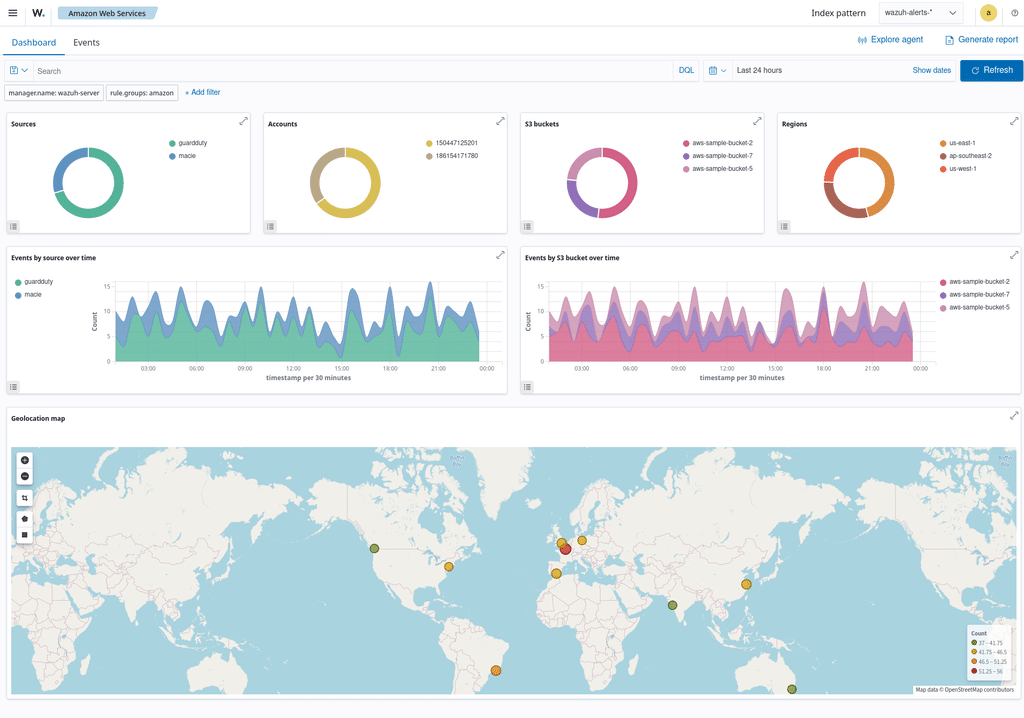
Cloud coverage depends on the integrations, permissions, log sources, and retention settings actually configured. A dashboard cannot show activity it never received. Before relying on cloud records as evidence, confirm that relevant accounts and services are in scope, the collection is working, and the data can be retrieved for the period being reviewed. Wazuh’s cloud workload protection documentation describes its endpoint and cloud-infrastructure monitoring approach.
TURN REPORTING INTO A REPEATABLE CONTROL
A useful evidence process is more than a dashboard export. The organization needs a defined scope and a repeatable way to produce, review, and retain reports.
A practical workflow can include:
- Define scope: Identify ePHI systems, critical endpoints, cloud accounts, and other data sources to monitor.
- Map ownership: Assign who reviews alerts, configuration findings, and exceptions, and who approves remediation.
- Set a cadence: Establish regular review and reporting intervals that fit your policies and risk analysis.
- Preserve context: Record the time period, systems covered, filters used, findings, decisions, and follow-up actions.
- Protect the evidence: Apply appropriate access controls and retention rules to logs and reports.
- Validate coverage: Periodically check that agents and cloud integrations are still collecting the expected data.
Wazuh dashboards and report-generation capabilities can reduce manual evidence gathering when they are configured around those decisions. The schedule and evidence package require operational planning, including choosing report contents, review owners, retention periods, and recipients. Cenova Cyber’s security monitoring service pairs Wazuh monitoring with analyst investigation and reporting to help make that work part of an ongoing process.
WAZUH IS A TOOL IN THE COMPLIANCE PROGRAM, NOT THE PROGRAM
Wazuh can help your team see security activity, assess endpoint configurations, monitor selected cloud services, and organize technical evidence around framework mappings. That can make regular reviews more consistent and reduce the scramble to assemble records later.
But the evidence only has value when it reflects real, documented work. Organizations remain responsible for conducting and maintaining their HIPAA risk analysis, establishing policies and procedures, responding to findings, and demonstrating that controls operate as intended. A control mapping is not an auditor’s approval, and an installed agent is not proof that the organization meets a requirement.
Build the evidence process around your actual risks. Cenova Cyber can help healthcare organizations align Wazuh security monitoring with HIPAA governance and risk management. Our HIPAA compliance services support the governance layer, while our vCISO services can help establish security priorities and accountability.
Contact Cenova Cyber to schedule a HIPAA and security monitoring consultation. Let’s assess what you monitor today, where evidence gaps remain, and how to build a reporting process your team can maintain.