
Ransomware Affiliates Now Run AI Agents: The Intrusion Playbook Just Got an Intern

AI can help ransomware operators research targets, plan steps, and make sense of stolen data. It does not remove the need for human decisions, or erase the traces an intrusion leaves behind.
That distinction matters. Recent reporting on exposed infrastructure tied to affiliates associated with INC Ransomware and The Gentlemen describes an AI-assisted workflow that could help operators work faster and repeat tasks across campaigns. The defensive response is not panic. It is better visibility, behavioral detection, and a faster path from alert to action.
WHAT THE EXPOSED PHANTOM INFRASTRUCTURE REVEALS
In October 2026, SOCRadar reported that researchers found an exposed server containing AI session records, a knowledge base, and source code for Phantom, a framework described as an “Autonomous Red Team Kill Chain Framework.” Analysis of the exposed environment connected it to ransomware affiliates and their intrusion operations.
The important detail is how the system was reportedly used. Researchers found evidence of an AI-assisted, human-approved workflow: operators directed activity and approved actions, while AI tools helped with tasks such as planning reconnaissance, generating commands, organizing campaign information, and reviewing data. Atos’s analysis likewise cautions that the evidence does not establish autonomous AI conducting intrusions on its own.
Think of the AI as an intern with a large reference library and the ability to prepare work quickly, not an independent operator with unrestricted authority. The human still makes decisions. But the human may spend less time on repetitive research, scripting, and analysis.

The leaked records offer a view into one particular environment, not a representative measure of all ransomware activity. SOCRadar reported analyzing 8,257 messages across 133 AI sessions; those figures describe the exposed dataset, not how commonly ransomware groups use AI across the industry.
WHAT CHANGES FOR DEFENDERS
AI assistance can change the economics and pace of an attack without changing the basic need to gain access and move through an organization.
More attempts, with less manual effort
When research and routine tasks take less operator time, an attacker may be able to test more targets or pursue more leads. That does not mean every attempt will work, or that AI makes every operation effective. It does mean security teams should not assume that low attacker capacity will limit exposure.
Reconnaissance can move faster
AI can help organize publicly available information, identify likely entry points, and summarize what an operator finds. Work that might otherwise take days, or, in some cases, longer, could be accelerated. However, the exposed Phantom reporting does not establish a universal or measured “weeks to hours” reduction. Treat faster reconnaissance as a credible operational advantage, not a guaranteed timeline.
Phishing may be more convincing
AI can help produce fluent, context-aware messages and adapt wording for a particular role, company, or business process. Broken English is not a dependable warning sign. An email that reads naturally can still be fraudulent; employees need to verify unusual requests through trusted channels, especially those involving payments, credentials, or sensitive files.
The answer is not to abandon awareness training. It is to stop treating training as the control that must catch every attack.
THE DEFENSIVE ASYMMETRY: BEHAVIOR STILL LEAVES A TRAIL
AI may help an operator decide what to do next. It cannot make an intrusion happen without interacting with real systems, accounts, applications, and data. Those interactions produce telemetry that defenders can use.
Look for connected signals, not just one suspicious login or one unusual process:
- Authentication anomalies: unusual sign-ins, new locations or devices, repeated failures followed by success, and access at atypical times.
- Unexpected process activity: scripting or administrative tools launched by applications or users that do not normally use them.
- Account and privilege changes: new privileged accounts, altered access rights, or authentication changes outside an approved process.
- Lateral movement patterns: a user or device reaching systems it does not typically access, especially across sensitive network segments.
- Data collection and staging: unusual file access, bulk archiving, or preparation of data for transfer.
- Potential exfiltration: unexpected outbound volume or transfers to services that are not part of normal business activity.
These are not automatic proof of an intrusion. Legitimate administrators and business workflows can create similar events. The value comes from correlating activity across identity, endpoint, cloud, and network sources, then judging it against the organization’s normal patterns and the asset’s importance.
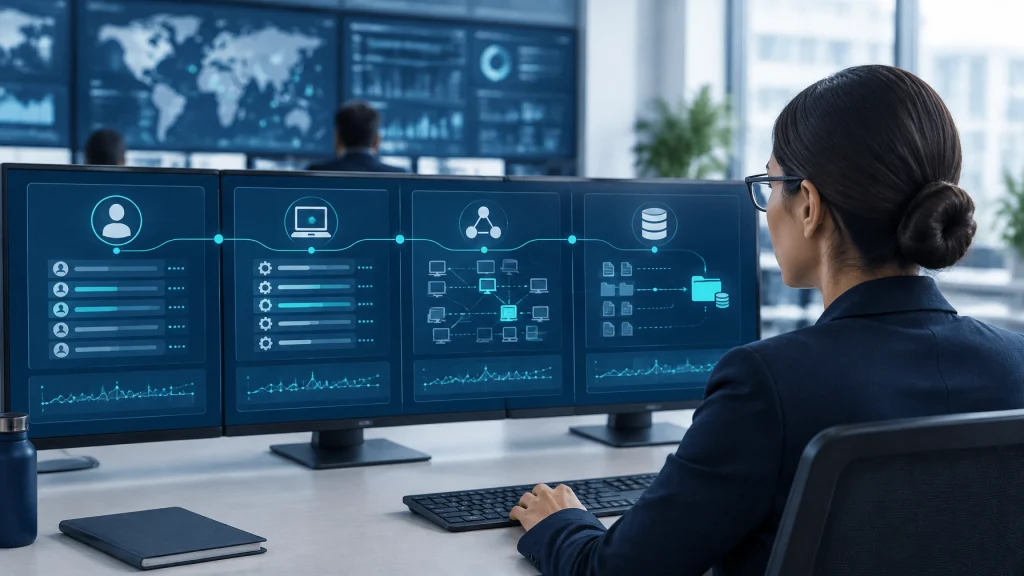
This is why detection quality depends on visibility. If identity logs are disconnected from endpoint alerts, a series of ordinary-looking actions may never add up to a clear incident. A monitored environment can connect the events, prioritize what matters, and give responders enough context to investigate quickly.
TRAINING STILL MATTERS, BUT IT IS NOT THE LAST LINE
Employees remain an important part of defense. Training helps people question unexpected requests, report suspicious activity, and use established verification procedures. It can reduce the chance that a convincing message leads to a compromised account.
But training cannot reliably stop a phishing attempt from reaching an inbox, prevent an attacker from exploiting an exposed service, or identify suspicious activity after valid credentials are abused. Those are reasons to combine awareness with technical controls and monitoring.
A resilient program layers protections:
- Enforce multi-factor authentication, especially for remote access and privileged accounts.
- Patch internet-facing systems and restrict management interfaces to authorized networks.
- Limit administrative privileges and use separate accounts for administrative work.
- Monitor endpoint, identity, cloud, and network activity together.
- Protect backups and test recovery processes.
- Define who can isolate a device, disable an account, and escalate an incident, and how quickly those actions can happen.
MONITORING MAKES SPEED A DEFENSIVE ADVANTAGE
When an attacker can research and iterate faster, defenders need a reliable way to recognize behavior and act on it. That means more than collecting logs. It requires continuous monitoring, alert investigation, clear escalation paths, and response procedures that are ready before an incident.
Cenova Cyber’s 24/7 security monitoring combines SIEM, MDR, SOAR automation, AI-assisted enrichment, threat intelligence, and analyst validation. Our SOC collects telemetry from endpoints, identity systems, cloud platforms, and network devices; correlates activity; prioritizes risk; and investigates suspicious behavior. When a real threat is identified, analysts can support containment and provide clear next steps.
That approach matters whether an attacker’s actions come from a person working manually or from a person using AI tools. Detection should focus on what is happening in your environment, not on guessing who or what generated the next command.

Cenova Cyber’s managed cybersecurity services can also help organizations strengthen security operations, reduce complexity, and support ongoing risk and compliance needs, fully managed or alongside an internal IT team.
RESPOND TO THE BEHAVIOR, NOT THE HYPE
The Phantom reporting is a meaningful signal: some ransomware affiliates are integrating AI into their operational workflows. It is not proof that autonomous agents can independently break into any organization or that conventional defenses no longer work.
The practical lesson is more grounded. AI may increase the pace and polish of attacker activity, but intrusions still involve access, accounts, processes, movement through systems, and data handling. Those actions create opportunities for detection, if your organization has the right telemetry and someone is prepared to investigate it.
Request a free security assessment from Cenova Cyber. We’ll help identify visibility gaps, review your monitoring and response readiness, and outline practical next steps for your environment. Contact Cenova Cyber to get started.