
65% of SMBs Now Outsource Security: The Seven Questions That Separate a Real SOC From a Dashboard

Outsourcing security can give your organization expertise and coverage it would be difficult to build alone. But a contract, a dashboard, and a stream of alerts do not automatically add up to a managed security operation.
The headline’s 65% figure comes from a 2026 industry-statistics compilation that does not identify its underlying survey methodology. The same compilation attributes 73% to a lack of in-house expertise, but that figure also lacks a clearly traceable primary source. Treat both as directional claims, not verified benchmarks.
More transparent research points to the same underlying challenge. A 2024 Microsoft survey of U.S. and U.K. SMB security decision-makers found that fewer than 30% managed security in-house. In a 2024 ConnectWise survey, 76% of respondents said their organizations lacked the in-house skills to handle cybersecurity issues, and 57% said they outsourced all or most cybersecurity. Different surveys measure different populations and behaviors, so those figures should not be treated as directly comparable.
Cost is part of the decision, too. A 2025 CrowdStrike survey found that 66% of SMB respondents cited cost as an obstacle to adopting more advanced security tools. That does not prove that managed security is cheaper for every organization. The real question is whether a provider delivers the coverage, expertise, and response you need, and whether the total cost makes sense for your business.
Use this guide to look past the label and evaluate the service.
FIRST, KNOW WHAT YOU’RE BUYING
These terms are related, but they are not interchangeable:
- MSSP: A managed security services provider. This describes the provider and its ongoing security services. It does not, by itself, guarantee a staffed SOC or hands-on incident response.
- Managed SOC: An outsourced security operations capability, combining people, processes, and technology to monitor activity, investigate events, and respond or escalate according to agreed procedures.
- MDR: Managed detection and response. A meaningful MDR service includes people investigating threats and supporting response, not simply antivirus alerts displayed in a portal.
- SIEM: Security information and event management technology. A SIEM collects and correlates security data. It is a tool, not a promise that anyone is watching, investigating, or containing threats.
Ask providers to describe their actual service, coverage, and response commitments, not just the products in their stack.
SEVEN QUESTIONS TO ASK EVERY PROVIDER
1. Who is watching at 3 a.m., and what happens on the night shift?
Ask whether analysts actively monitor your environment around the clock, where they are located, and what “24/7” means in the contract. Is it staffed analyst coverage, automated alerting with on-call escalation, or a combination?
Then ask the practical question: what happens when an alert fires overnight? Who reviews it, how do they contact your team, and what if the primary contact does not respond? Get the coverage window, escalation path, and after-hours responsibilities in writing.
2. How do you measure detection and response time?
Ask for the provider’s mean time to detect (MTTD) and mean time to respond (MTTR), and how those metrics are calculated. Find out when the clock starts and stops, which incidents count, and whether the figures reflect your service tier or a company-wide average.
A useful answer includes definitions, reporting frequency, and enough context to understand performance. A number without a clear measurement method is not a service commitment.
3. How do you validate alerts before escalating them?
An alert is a lead, not a conclusion. Ask how analysts gather context, correlate activity across systems, and decide whether an event is benign, suspicious, or an incident.
Request the provider’s severity tiers and examples of what triggers each one. Ask what information appears in an escalation: affected account or device, evidence reviewed, likely business impact, recommended action, and urgency. If a provider cannot explain how it reduces false positives, your team may end up doing the investigation itself.
4. Can you contain a threat, or only notify us?
Clarify whether the service can take action, such as isolating an endpoint, disabling an account, or executing an agreed response playbook. Ask what actions are included, what requires your approval, and how authority is documented.
Neither “we handle everything” nor “we send an alert” is enough. You need a clear responsibility matrix that matches your risk tolerance, business hours, and operational requirements.
5. What happens when an incident becomes a breach?
Ask the provider to walk you through a realistic incident: from first detection through investigation, containment, recovery coordination, and post-incident reporting. Who leads communications? Who preserves evidence? Who works with your internal team, counsel, insurer, or incident-response firm?
For regulated organizations, establish reporting responsibilities and timeframes in advance. A monitoring provider may support an incident without replacing your legal, regulatory, insurance, or breach-notification obligations.
6. What evidence can you provide for auditors, regulators, and insurers?
Ask for sample reports or redacted records showing alert review, incident investigation, escalation, remediation tracking, and service activity. Confirm what evidence is available, how often it is delivered, and how long relevant logs and records are retained.
For healthcare organizations, HIPAA’s Security Rule requires appropriate safeguards, including audit controls and documented risk analysis. It does not require a particular vendor or security product. Your organization remains responsible for its compliance program, so define the provider’s role and evidence obligations in the contract and, where applicable, the business associate agreement.
Compliance and insurance readiness can take significant staff time. A provider should make evidence easier to assemble, not claim that a dashboard alone makes you compliant.
7. What is the exit plan if we leave?
Ask how you retrieve your data, logs, reports, and incident records; what format they come in; when access ends; and how the provider handles data deletion. Confirm notice periods, transition support, and any dependencies on proprietary tools or configurations.
A credible provider can explain offboarding before you sign. Your security history should not become inaccessible because you changed vendors.

WARNING SIGNS: MANAGED ON PAPER, NOT IN PRACTICE
Look more closely if a provider:
- Uses alert volume as its primary success metric. More alerts do not necessarily mean better detection.
- Offers quarterly review calls but cannot show meaningful incident detail or operational reporting.
- Has no documented severity tiers, escalation rules, or response responsibilities.
- Cannot provide records of what was reviewed, what was escalated, and what happened next.
Good reporting helps you understand risk and make decisions. It should not be a substitute for daily monitoring or a record of activity that nobody can explain.
LOOK FOR A PROGRAM, NOT A SINGLE TOOL
A SOC or MDR service is one part of a security program. Your organization may also need vulnerability management, compliance support, and executive-level guidance to connect security work to business priorities.
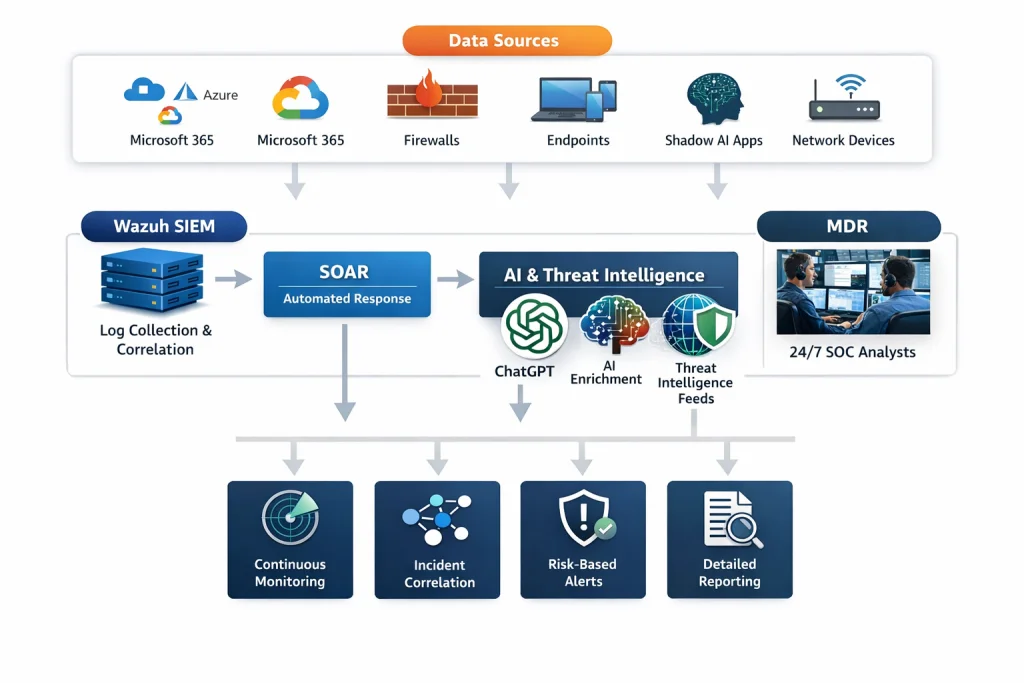
Cenova Cyber describes its managed cybersecurity services as a combination of protection, monitoring, response, and compliance support. Its managed cybersecurity services include a US-based 24/7 SOC and options for fully managed or co-managed security. Its security monitoring service combines SIEM, SOAR, threat intelligence, and MDR analysts for investigation and response.
Depending on your needs, the broader program can also include Vulnerability Management as a Service, HIPAA compliance support, and vCISO services. Together, these services address more than alert collection: they help organizations identify weaknesses, manage risk, and build a more supportable security and compliance program.

MAKE THE BUYING DECISION WITH EVIDENCE
The best provider is not necessarily the one with the longest feature list. It is the one that can clearly explain who is responsible, what happens when a threat appears, how results are measured, and what evidence your organization receives.
Compare providers against the same written questions. Ask for sample reports, response procedures, and contract language. Then assess the service against your actual environment, obligations, and ability to respond internally.
Request a free security program review from Cenova Cyber. We’ll help you assess your current coverage, identify practical gaps, and determine what kind of support fits your organization.