
Scan-and-Dump Is Dead: What a Real Vulnerability Management Program Actually Looks Like in 2026
A monthly vulnerability scan can tell you what was exposed on the day it ran. It cannot tell you what changed yesterday, which vulnerabilities attackers are exploiting now, or whether your most important systems remain protected today.
That gap is now a measurable business risk.
The 2026 Verizon Data Breach Investigations Report found that software vulnerability exploitation accounted for 31% of breaches, making it the leading initial access vector. The same report found that the median time to fully remediate critical vulnerabilities increased to 43 days.
Attackers move in hours and days. Traditional vulnerability programs often respond in weeks.
A scanner is useful. A PDF is useful. But neither one is a vulnerability management program.
THE SCAN-AND-DUMP MODEL IS FAILING
The traditional process is familiar:
- Run a vulnerability scan once a month, or once a quarter.
- Export a long PDF containing hundreds or thousands of findings.
- Sort the findings primarily by CVSS severity.
- Send the report to IT.
- Expect an already-busy team to determine what matters, assign ownership, coordinate remediation, and confirm the fix.
- Repeat the process during the next scan cycle.
This model detects weaknesses. It does not reliably reduce risk.
A monthly scan becomes stale as soon as:
- A new device is connected.
- A cloud workload is deployed.
- A firewall rule changes.
- An internet-facing application is updated.
- A critical CVE is published.
- A previously safe system becomes reachable from the internet.
The report may be accurate when delivered, and irrelevant by the time someone has capacity to review it.
FIVE PROBLEMS WITH MONTHLY SCANS AND PDF REPORTS
1. ALERT FATIGUE
A large finding count does not create clarity. It creates noise.
When every vulnerability appears urgent, nothing is truly prioritized. IT teams spend time reviewing low-impact issues while high-probability exploitation risks remain open.
2. NO BUSINESS CONTEXT
CVSS measures technical severity. It does not understand your business.
A moderate-severity vulnerability on an internet-facing payment system may create more practical risk than a critical vulnerability on an isolated test server. Without asset criticality, exposure, data sensitivity, and system dependencies, severity scores alone cannot produce a useful remediation queue.
3. CVSS-ONLY PRIORITIZATION
A CVSS score describes potential impact. It does not tell you whether attackers are likely to exploit a vulnerability today.
Modern prioritization must also consider:
- EPSS: The probability that a vulnerability will be exploited in the near term
- CISA KEV status: Whether the vulnerability is already known to be exploited in the wild
- Internet exposure: Whether the affected asset is directly reachable
- Business criticality: What operations depend on the asset
- Data sensitivity: Whether it stores regulated or confidential information
- Attack paths: Whether the system connects to other high-value resources
A CVSS score is one signal, not the decision.
4. NO REMEDIATION OWNERSHIP
A report may identify a vulnerable server, but who is responsible for fixing it?
Without an assigned owner, deadline, ticket, escalation path, and documented exception process, remediation becomes optional. Findings age in spreadsheets while teams move on to the next operational priority.
5. NO VALIDATION
“Patch applied” does not automatically mean “risk removed.”
The patch may have failed. The wrong system may have been updated. A vulnerable service may still be exposed. The issue may have been caused by a configuration that remains unchanged.
A mature program verifies the result with a rescan or targeted validation check.
THE 2026 THREAT LANDSCAPE DEMANDS CONTINUOUS VISIBILITY
The 2026 DBIR’s 31% vulnerability exploitation rate is a clear signal: organizations must treat vulnerability management as an active security control, not a periodic compliance task.
The 43-day median remediation time creates a dangerous window. A critical vulnerability can remain exposed for more than six weeks after it is identified, especially when security teams lack the staff, context, or workflow to act quickly.
That is why modern vulnerability management starts with a live understanding of the environment.
You cannot protect what you do not know exists.
WHAT A REAL VULNERABILITY MANAGEMENT PROGRAM LOOKS LIKE
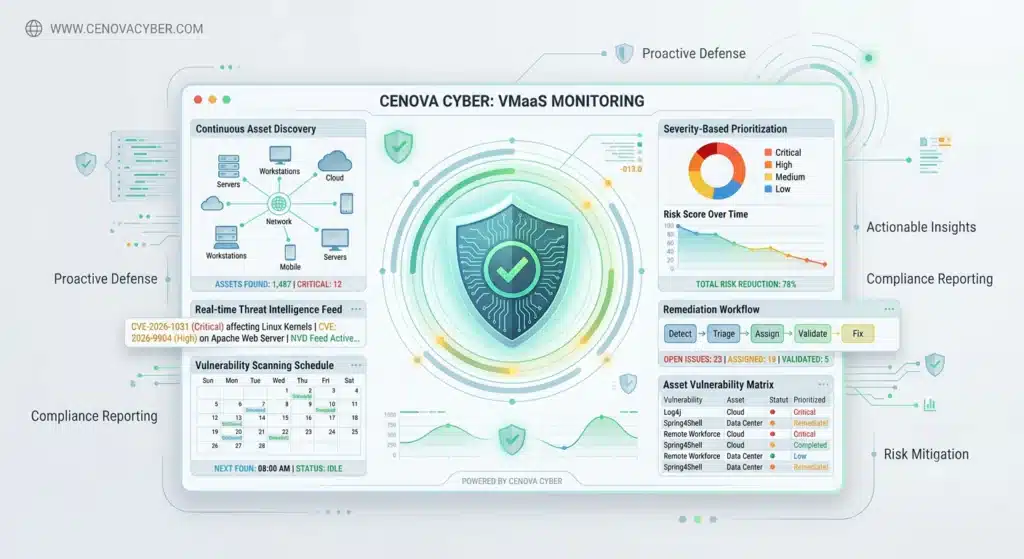
A 2026-ready program connects discovery, prioritization, remediation, validation, and reporting into one continuous lifecycle.
1. CONTINUOUS ASSET DISCOVERY
The first question is not “How many vulnerabilities do we have?”
It is: What assets do we actually have?
A complete inventory should identify:
- Endpoints and servers
- Internet-facing systems
- Cloud workloads and services
- Active Directory resources
- Network devices
- Web applications
- Microsoft 365 and other critical platforms
- Unmanaged and shadow IT assets
Asset discovery must continue as the environment changes. New devices, cloud resources, software versions, and exposed services should enter the risk picture without waiting for the next quarterly scan.
2. RISK-BASED PRIORITIZATION
The goal is not to fix every finding at once. The goal is to fix the findings that create the greatest business risk first.
A risk-based program combines:
This produces a focused risk register instead of an unmanageable list of CVEs.
A moderately rated vulnerability with a high EPSS score on an exposed system may deserve immediate attention. A critical vulnerability with low exploit probability on an isolated asset may be scheduled differently.
The priority should reflect reality: not just a number.
3. GUIDED AND COORDINATED REMEDIATION
Vulnerability management does not end when a finding is discovered.
A useful program helps your team determine the right response:
- Apply a security patch.
- Upgrade unsupported software.
- Remove an exposed service.
- Correct a cloud or firewall configuration.
- Restrict access.
- Isolate the affected system.
- Implement a compensating control.
- Accept or defer the risk with documented justification.
Each high-priority finding should have an owner, a remediation target, and an escalation process. Exceptions should have an expiration date: not become permanent gaps hidden in a spreadsheet.
4. VALIDATED CLOSURE
A ticket marked “complete” is not proof of remediation.
A mature program rescans or performs targeted validation to confirm that:
- The vulnerable software version is no longer present.
- The configuration has been corrected.
- The exposed service is no longer reachable.
- The exploit path has been closed.
- The remediation applies to every affected asset.
This evidence matters operationally and during audits. It demonstrates that your team did more than identify risk: it reduced it.
5. COMPLIANCE-READY REPORTING
Security leaders, executives, auditors, and cyber insurers need more than a raw scan export.
A real vulnerability management program should provide clear reporting for different audiences:
- Technical teams: A prioritized remediation queue with affected assets and recommended actions
- Managers: Risk trends, remediation progress, overdue findings, and SLA performance
- Executives: Business exposure, material risk, and whether the organization is improving
- Auditors: Evidence of scanning, prioritization, remediation, validation, and documented exceptions
Cenova Cyber’s VMaaS reporting supports frameworks and requirements including HIPAA, NIST 800-171, CMMC Level 2, SOC 2, and PCI DSS.
HOW CENOVA CYBER’S VMAAS CLOSES THE GAP
Cenova Cyber Vulnerability Management as a Service replaces scan-and-dump reporting with a full-lifecycle program.
Our technology stack combines:
- ConnectSecure for internal, external, cloud, and Active Directory vulnerability scanning, EPSS-based exploit prediction, and compliance mapping
- NinjaOne for endpoint visibility, patch deployment, and remediation tracking across managed devices
- Ongoing vulnerability intelligence updates to help identify new exposure as CVEs and threat information emerge
The result is a practical workflow:
Discover → Prioritize → Assign → Remediate → Validate → Report
We do not simply hand your team another PDF and walk away. We help turn findings into an actionable program aligned with your environment, resources, and business priorities.
For organizations without dedicated vulnerability management staff, VMaaS adds the expertise and operational discipline needed to keep exposure under control. For internal IT teams, it reduces manual triage and helps them focus on the work that matters most.
STOP MEASURING REPORTS. START MEASURING RISK REDUCTION.
A monthly scan can be part of a vulnerability management program. It cannot be the program.
In 2026, effective vulnerability management requires:
- Continuous asset discovery
- Risk prioritization using EPSS, CVSS, KEV, and business context
- Clear remediation ownership
- Defined response timelines
- Guided remediation
- Verified closure
- Compliance-ready evidence
The question is no longer whether your scanner found vulnerabilities.
The question is whether your organization can identify what matters, fix it before attackers exploit it, and prove that the risk is closed.
Do not wait for the next report: or the next breach: to discover the gaps in your vulnerability program.
Book a free Vulnerability Management consultation with Cenova Cyber. In 20 minutes, we can review your current scanning process, remediation delays, asset visibility, and the steps required to build a more effective VMaaS program.
Learn more about Cenova Cyber’s Vulnerability Management as a Service or explore our security monitoring services.