
31% of Breaches Start Here: The Vulnerability Exploitation Wave and How to Get Ahead of It
For years, stolen credentials dominated the conversation around initial access. That threat has not disappeared: but the balance is shifting.
According to the 2026 Verizon Data Breach Investigations Report, vulnerability exploitation now accounts for 31% of data breaches, making it the leading initial access vector and overtaking credential theft.
That change matters to every organization. It matters even more to small and midsize businesses, healthcare providers, government contractors, financial firms, and other regulated organizations that often operate with limited security staff and complex technology environments.
Attackers do not need to defeat your entire security program. They need to find one unpatched, misconfigured, or internet-facing weakness: and reach it before your team does.
THE VULNERABILITY WINDOW IS GETTING WIDER
The most concerning part of the current trend is not just the increase in exploitation. It is the time organizations remain exposed after a critical weakness becomes known.
The 2026 DBIR reports:
- 31% of breaches involve vulnerability exploitation.
- The median time to resolve critical vulnerabilities is now 43 days.
- Only 26% of CISA Known Exploited Vulnerabilities (KEVs) were remediated in the measured period.
- Vulnerability exploitation has overtaken credential abuse as the most common initial access vector.
A 43-day remediation window gives attackers a significant opportunity. Once a vulnerability is publicly documented: and especially once exploitation is confirmed: criminal groups can move quickly to scan the internet for exposed systems.
The CISA Known Exploited Vulnerabilities Catalog is particularly important because it tracks vulnerabilities that attackers are actively using in the wild. These are not theoretical risks. They are weaknesses with demonstrated exploitation.
When only a fraction of these vulnerabilities are remediated, organizations are not simply accepting technical debt. They are leaving known attack paths open.
WHY ATTACKERS ARE SHIFTING TO VULNERABILITIES
Attackers follow efficiency. Vulnerability exploitation offers several advantages that make it attractive at scale.
1. ONE EXPLOIT CAN REACH THOUSANDS OF ORGANIZATIONS
A phishing campaign requires messages, infrastructure, and some level of social engineering. Exploiting an internet-facing vulnerability can be more direct.
Attackers can scan for exposed VPN appliances, firewalls, remote access systems, web applications, cloud services, and other technologies. When a vulnerable version is discovered, automated tools can attempt exploitation across thousands of targets.
Your company does not need to be famous. It only needs to be reachable.
2. PUBLIC DISCLOSURE CREATES A RACE
When a vulnerability is disclosed, defenders and attackers often receive the same information. Security teams begin evaluating patches, testing compatibility, scheduling downtime, and coordinating approvals.
Attackers begin scanning.
That difference in operating speed creates a dangerous gap. A business may know that a critical vulnerability exists but still remain exposed while teams determine:
- Which assets are affected
- Whether the systems are internet-facing
- Whether a patch is available
- Whether business applications will break
- Who owns remediation
- How to validate that the fix worked
Without a defined process, awareness does not become protection.
3. COMPLEX ENVIRONMENTS CREATE BLIND SPOTS
Many organizations do not have a complete, current inventory of their technology assets. Cloud workloads, remote endpoints, shadow IT, forgotten servers, third-party applications, and unmanaged devices can all create exposure.
You cannot patch what you cannot see.
A vulnerability program that scans only known endpoints may miss the system attackers find first.
4. MISCONFIGURATION CAN BE AS DANGEROUS AS A MISSING PATCH
Vulnerability exploitation is not limited to outdated software. Misconfigured cloud storage, excessive permissions, exposed management interfaces, insecure remote access, and weak segmentation can also provide an entry point.
That is why effective vulnerability management must examine more than CVE numbers. It must account for asset criticality, exploit likelihood, exposure, configuration, and business impact.
WHAT THIS MEANS FOR SMALL AND MIDSIZE BUSINESSES
The idea that a small business is too insignificant to attack is no longer realistic.
Automation has changed the economics of cybercrime. Attackers can identify vulnerable systems without manually researching each target. Ransomware groups can purchase access through criminal marketplaces. Exploit kits and ransomware-as-a-service reduce the technical expertise required to launch an attack.
SMBs are often attractive targets because they may have:
- Fewer dedicated security personnel
- Limited time for patch testing and remediation
- Older infrastructure that supports essential business applications
- Incomplete asset inventories
- Flat networks and broad administrative access
- Third-party vendors with privileged connections
- Compliance obligations without the staff to manage them
Attackers do not measure your size the way you do. They measure exposure.
For regulated organizations, the consequences extend beyond downtime. A successful exploit can trigger notification requirements, contractual penalties, audit findings, cyber insurance complications, legal costs, and reputational damage.
A vulnerability management program helps reduce that risk while creating documented evidence that your organization is actively identifying and addressing security weaknesses.

SCANNING IS NOT VULNERABILITY MANAGEMENT
A monthly scan and a lengthy PDF are not enough.
Traditional scanning often produces thousands of findings ranked primarily by severity. That creates a familiar problem: IT teams receive more alerts than they can reasonably investigate, while the most dangerous exposures may remain buried in the list.
Effective vulnerability management closes the gap between finding a weakness and fixing the weakness.
A mature program answers five practical questions:
- What assets do we have?
- Which assets are exposed or business-critical?
- Which vulnerabilities are actively being exploited?
- What should we fix first?
- How do we verify that remediation is complete?
CVSS scores remain useful, but they should not be the only factor. A medium-severity vulnerability on an internet-facing system may deserve faster attention than a critical issue on an isolated, low-impact device.
Prioritization must reflect the environment: not just the number attached to a vulnerability.
GET AHEAD WITH CONTINUOUS VULNERABILITY MANAGEMENT
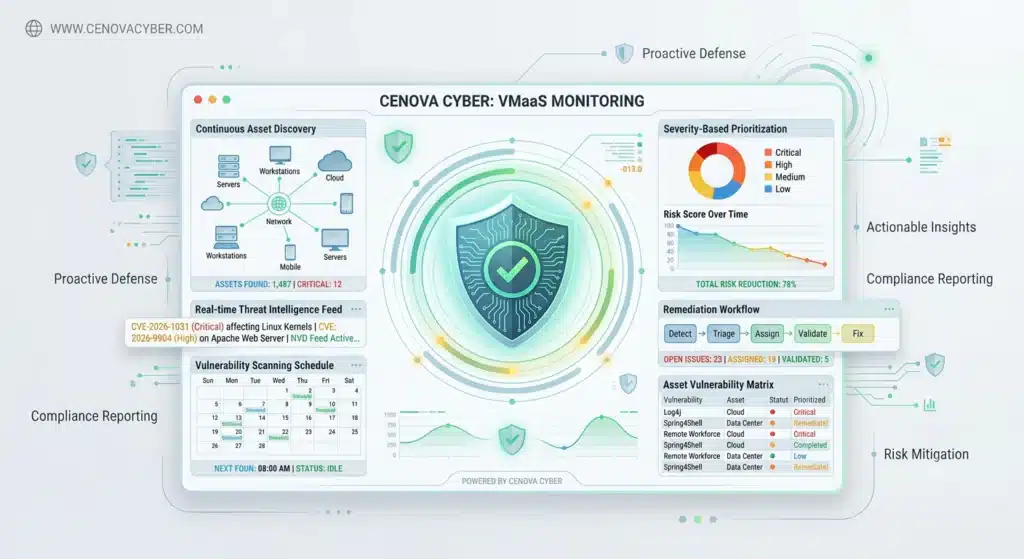
Cenova Cyber’s Vulnerability Management as a Service (VMaaS) helps organizations move from point-in-time scanning to a continuous, risk-based remediation program.
Our approach includes:
ASSET DISCOVERY AND BASELINE INVENTORY
We identify endpoints, servers, cloud workloads, internet-facing systems, Active Directory assets, and other components across your environment. This creates a current exposure baseline and helps reveal unmanaged or overlooked technology.
INTERNAL AND EXTERNAL SCANNING
We conduct recurring assessments across internal networks, external attack surfaces, cloud environments, web applications, and critical infrastructure. Scan schedules are tailored to your risk profile and compliance requirements.
RISK-BASED PRIORITIZATION
We evaluate findings using exploit probability, asset criticality, exposure, and business context. This gives your team a focused risk register instead of an unmanageable spreadsheet.
GUIDED REMEDIATION AND TRACKING
We coordinate remediation workflows, track issues through resolution, and work with your team to address the vulnerabilities that create the greatest risk. You receive visibility into ownership, status, deadlines, and outstanding exposure.
VALIDATION SCANNING
A patch is not the same as verified remediation. We perform validation scans to confirm that vulnerabilities have actually been closed and that the affected systems are no longer reporting the same exposure.
COMPLIANCE-READY REPORTING
VMaaS reporting supports organizations working toward or maintaining requirements related to HIPAA, NIST 800-171, CMMC Level 2, SOC 2, PCI DSS, and cyber insurance.

TURN VULNERABILITY DATA INTO BUSINESS DECISIONS
Security leaders and business executives need more than technical findings. They need to understand exposure in terms of operational risk.
A useful vulnerability management program shows:
- Which systems create the greatest business risk
- Which critical vulnerabilities remain unresolved
- Whether remediation is meeting internal service-level targets
- How exposure is changing over time
- Which risks require investment, replacement, segmentation, or compensating controls
- Whether the organization can demonstrate responsible risk management to auditors and insurers
Cenova Cyber’s VMaaS combines continuous discovery, risk-based prioritization, remediation coordination, and validation. Our technology stack supports internal, external, cloud, and Active Directory scanning, exploit prediction, endpoint visibility, patch deployment, and remediation tracking.
The objective is not to eliminate every vulnerability overnight. That is not realistic for most organizations.
The objective is to ensure that the vulnerabilities most likely to be exploited: and most damaging to your business: are identified, assigned, addressed, and verified before attackers take advantage of them.
DO NOT WAIT 43 DAYS TO START
The vulnerability exploitation wave is already here. The organizations that reduce their risk will not necessarily be the ones with the largest security budgets. They will be the ones with the clearest visibility, strongest prioritization, and most consistent remediation process.
Find your exposure before attackers do.
Contact Cenova Cyber for a free vulnerability consultation. We will help you understand where your environment stands, which weaknesses deserve immediate attention, and how a continuous VMaaS program can support your security, compliance, and business continuity goals.