
$893M in AI Fraud: Why a Cloned Executive Voice Is Now Your Biggest Financial Control Gap

A voice message arrives from your CEO.
The voice sounds right. The timing makes sense. The request is urgent: authorize a wire transfer, change vendor banking details, or send sensitive information before the end of the day.
Your employee calls back. The executive answers. The voice matches perfectly.
The request is fraudulent.
This is the new business email compromise (BEC) problem. Attackers are no longer relying on a suspicious email alone. They are combining AI-written messages, cloned voices, synthetic video, and forged documents to create a convincing, multi-channel impersonation campaign.
Traditional email filtering and security awareness remain important. They are no longer enough.
The biggest control gap is now found in the process that turns a request into an approved payment.
THE NUMBERS ARE ALREADY MATERIAL
The FBI’s 2025 Internet Crime Report introduced a dedicated AI-related category. The report recorded:
- 22,364 AI-related complaints
- Approximately $893.3 million in adjusted losses
- More than $30.2 million in losses tied to AI-referenced BEC complaints
These figures represent only complaints where victims specifically identified AI involvement. The actual total is likely higher because many organizations do not recognize that a cloned voice, generated document, or synthetic video played a role in the fraud.
The financial impact can be severe. Research from Regula reports that financial organizations affected by voice-deepfake incidents lose an average of approximately $600,000, with 23% reporting losses exceeding $1 million.
That statistic is sector-specific, but the lesson applies broadly: when attackers manipulate payment authorization, a single successful conversation can create a seven-figure business event.
THE OLD BEC PLAYBOOK HAS CHANGED
Traditional BEC attacks typically depend on:
- A spoofed or compromised email account
- A convincing payment request
- Pressure, secrecy, or urgency
- An employee who bypasses normal procedures
Organizations responded with email filtering, phishing awareness training, domain protection, and user reporting processes.
Those controls still reduce risk. But AI-enabled fraud adds a new layer of credibility.
An attacker may now:
- Study an executive’s public interviews and social media posts
- Clone the executive’s voice
- Generate a realistic video call
- Create a forged invoice, contract, or letter of authorization
- Send a carefully written email from a compromised mailbox
- Follow up by phone to “confirm” the request
The employee is not responding to one suspicious message. They are receiving a coordinated narrative across several trusted channels.
That is why a cloned executive voice can bypass a well-trained employee. The employee may do exactly what the organization taught them to do: call the executive and confirm the request.
If the callback goes to an attacker-controlled number, or the attacker has compromised the executive’s communications, the verification step becomes part of the fraud.
MULTI-CHANNEL DEEPFAKES CREATE FALSE CONFIDENCE
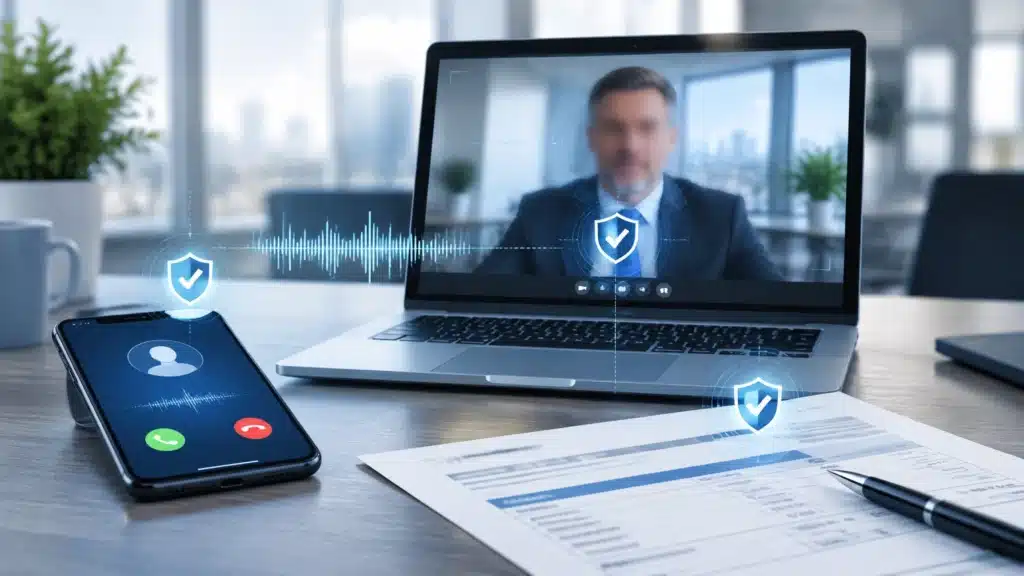
The defining trend in 2026 is not simply better deepfake quality. It is coordination.
Attackers are combining multiple forms of synthetic media to reinforce the same false identity:
Each channel appears to validate the others.
The email makes the phone call seem legitimate. The phone call makes the video meeting seem legitimate. The forged document gives finance a reason to process the transaction.
This is not a technology problem alone. It is a trust and authorization problem.
A realistic voice should never be treated as proof of identity. Neither should a familiar face, email address, caller ID, or supporting document.
YOUR PAYMENT PROCESS IS THE REAL CONTROL GAP
Email security can block malicious messages. Endpoint monitoring can detect suspicious logins. Security awareness can help employees identify red flags.
But none of those controls directly determine whether a high-value payment should be released.
That decision belongs to your financial authorization workflow.
Review whether your organization has clear, enforceable controls for:
- New vendor bank accounts
- Changes to existing payment instructions
- High-value or unusual wire transfers
- Urgent requests outside normal business hours
- Payments involving secrecy or executive pressure
- Requests that bypass procurement or approval procedures
If a single employee can receive a call, hear a familiar voice, and authorize a large payment, the organization has a process weakness, even if every endpoint is fully patched.
FIVE DEFENSES TO IMPLEMENT NOW

1. REQUIRE DUAL AUTHORIZATION
No single person should be able to create and release a high-value wire transfer.
Use dual authorization with separate individuals responsible for:
- Initiating the payment
- Reviewing the beneficiary and amount
- Approving the final release
Set thresholds based on risk, not convenience. Require additional approval for new beneficiaries, changed banking instructions, and unusual payment destinations.
2. USE CALLBACK VERIFICATION TO A KNOWN NUMBER
Never verify a payment request using contact information included in the request.
Instead, call the executive, vendor, or customer using:
- A number stored in your approved contact directory
- A number previously validated through an established relationship
- A known internal extension or corporate directory
Do not rely on caller ID. Do not use a number supplied in an email, text message, voicemail, or video meeting.
3. CREATE CODE WORDS FOR HIGH-VALUE REQUESTS
Establish a process-specific code word or phrase for sensitive requests.
The code word should:
- Be changed periodically
- Never be stored in email signatures or shared documents
- Be known only to authorized participants
- Be required before payment instructions are acted upon
A code word is not a replacement for dual authorization. It is an additional signal that can expose an impersonation attempt.
4. ENFORCE MFA EVERYWHERE
MFA will not stop every deepfake payment scam, but it can help prevent the account compromise that often supports the fraud.
Require phishing-resistant or strong MFA for:
- Banking and payment platforms
- Remote access
- Cloud applications
- Administrative accounts
- Collaboration and messaging tools
Prioritize compromised executive and finance accounts. Attackers who gain access to those mailboxes can monitor conversations, create forwarding rules, and time their impersonation precisely.
5. MONITOR FOR ANOMALOUS BEHAVIOR
Detection must include more than malware and suspicious attachments.
Monitor for:
- New mailbox forwarding or deletion rules
- Unusual login locations or impossible travel
- Sign-ins from unfamiliar devices
- Sudden changes in executive communication patterns
- New MFA registrations
- OAuth consent to unfamiliar applications
- Unusual access to invoices, vendor records, or payment systems
- Login activity immediately before a payment request
A cloned voice may be difficult to identify during a conversation. The surrounding account and behavioral activity may still reveal the attack.
DETECTION PLUS GOVERNANCE IS THE ANSWER

AI-enabled fraud requires two capabilities working together.
Detection identifies suspicious activity across endpoints, cloud systems, identities, and mailboxes. Governance defines who can approve transactions, how exceptions are handled, and when a request must be independently verified.
Cenova Cyber’s Managed Detection and Response service provides 24/7 SOC monitoring, threat hunting, behavioral analytics, and rapid containment. Our team helps identify anomalous login behavior, compromised accounts, malicious mailbox activity, and other signals that may support an impersonation campaign.
Our vCISO services address the governance side. We help leadership teams establish security strategy, risk ownership, incident response planning, policies, and practical controls aligned with business priorities.
You need both.
A monitoring platform cannot compensate for an authorization process that allows one person to release a high-value payment. A policy cannot protect the organization if nobody is watching for compromised accounts and unusual behavior.
DO NOT LET A FAMILIAR VOICE BECOME AUTHORIZATION
The question is no longer, “Can our employees recognize a phishing email?”
Ask better questions:
- Can one person authorize a high-value payment?
- Do we independently verify changed banking instructions?
- Are callbacks made to trusted numbers?
- Do executives and finance teams use a secure code word?
- Are mailbox rules and anomalous logins monitored?
- Does leadership own the organization’s payment fraud risk?
- Can we contain a compromised account before the attacker completes the transaction?
A cloned executive voice is not a futuristic threat. It is a new way to exploit old process weaknesses.
Review your payment authorization and out-of-band verification workflows now. Then identify where detection, accountability, and response capabilities fall short.
Contact Cenova Cyber for a free security consultation and speak with our team about reducing your exposure to AI-enabled fraud, BEC, and deepfake impersonation.