
Vulnerability Management (VMaaS)
Find the Exposure Before Attackers Do
Every environment has vulnerabilities. The organizations that get breached aren’t the ones with the most, they’re the ones that don’t know which ones matter. A monthly scan and a 40-page PDF won’t tell you that.
Attackers move faster than a quarterly report ever will.
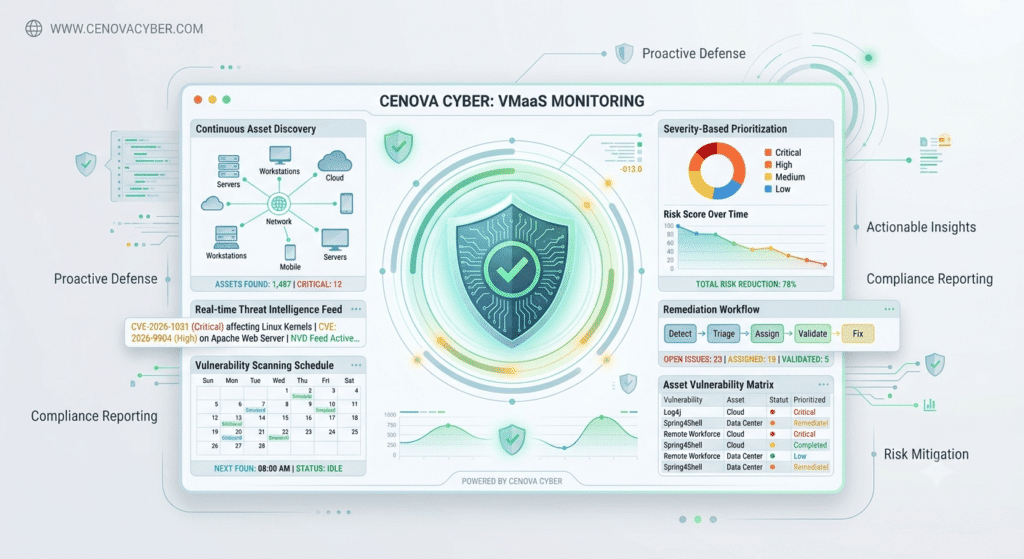
Vulnerability Management as a Service (VMaaS) from Cenova Cyber replaces point-in-time scanning with continuous discovery, risk-based prioritization, and guided remediation – so we fix what’s actually exploitable instead of chasing a spreadsheet of CVEs.
Why Traditional Vulnerability Scanning Falls Short
Most vulnerability programs stop at detection. A scanner finds thousands of findings, ranks them by CVSS severity alone, and hands IT a report with no context on what’s actually being exploited in the wild, what’s internet-facing, or what sits in front of your most sensitive systems. The result: alert fatigue, delayed patching, and audit gaps that show up at the worst possible time – during a breach or a compliance review.
VMaaS is built to close that gap between finding vulnerabilities and fixing the ones that put your business at risk.
What is vulnerability management as a service (VMaaS)?
Vulnerability management as a service is an ongoing, managed program that continuously finds weaknesses across your devices, servers, cloud and internet-facing systems, ranks them by real-world exploit risk, and coordinates fixes until they’re verified closed. It replaces one-time scans and long PDF reports with a cycle your team can actually act on.
How VMaaS works
- Discover — build a complete inventory of devices, cloud workloads and internet-facing assets.
- Scan — continuous internal, external, cloud and Active Directory scanning.
- Prioritize — rank findings by exploit likelihood and business impact, not CVSS alone.
- Remediate — coordinate patching and fixes with your team through to resolution.
- Validate and report — confirm fixes and deliver audit-ready reporting.
What We Deliver
1. Asset Discovery & Baseline Inventory
We identify every endpoint, server, cloud workload, and internet-facing asset across your environment — including the shadow IT and unmanaged devices most scanners miss. Deliverable: Complete Asset Inventory & Exposure Baseline
2. Continuous Internal & External Scanning
Scheduled and continuous scans across internal networks, external attack surface, cloud environments (AWS, Azure, M365), Active Directory, and web applications — not a once-a-quarter checkbox exercise. Deliverable: Recurring Vulnerability Scan Reports & Monthly Risk Assessment Dashboards
3. Risk-Based Prioritization
We go beyond raw CVSS scores. Findings are enriched with exploit-probability data, asset criticality, and business context so your team knows what to fix first — not just what has the highest severity number. Deliverable: Prioritized Risk Register
4. Guided & Coordinated Remediation
We don’t just hand you a list. Our team coordinates patch and remediation workflows, tracks tickets through resolution, and runs validation scans to confirm a vulnerability is actually closed. Deliverable: Remediation Tracking & Validation Report
5. Compliance-Ready Reporting
Every scan cycle produces two kinds of reports. Executive reports show leadership your overall risk, trends over time and progress against the SLA. Operational reports give your IT team the asset-level detail: open vulnerabilities, patch status and remediation tasks. Both are mapped to the frameworks you’re held to — HIPAA, NIST 800-171, CMMC Level 2, SOC 2, and PCI DSS. Deliverable: Executive, Operational & Compliance Reporting Package
Operating System and Third-Party Patch Management
Most successful attacks exploit software that was never patched. Keeping systems up to date is also a requirement of PCI DSS, HIPAA, NIST 800-171 and most cyber insurance policies. Cenova Cyber manages patching for you, not just the scanning.
- Operating systems: Windows, macOS and Linux security and feature updates on servers and workstations
- Third-party software: browsers, Adobe, Java, Zoom, Microsoft 365 apps and the other business applications attackers target most
- Automated deployment during approved maintenance windows, with rollback if an update causes problems
- Emergency patching for critical vulnerabilities that are being actively exploited
- Patch compliance reporting that shows which devices are up to date and which still need attention
Service Level Agreement (SLA)
Every VMaaS plan includes a written Service Level Agreement (SLA), so you know exactly what to expect and can show it to auditors and insurers. The SLA covers:
- How often your environment is scanned
- Remediation timelines by severity (critical, high, medium and low)
- Patch deployment windows for operating systems and third-party software
- Response times for actively exploited vulnerabilities
- Reporting schedule and SLA performance tracking in every executive report
Start with a free vulnerability baseline scan
Find out what attackers can see on your network today, with no cost and no obligation.
Prefer to talk? Call (844) 236-6820 (844-CENOVA0).
Powered by Enterprise-Grade Technology
Cenova Cyber’s VMaaS is built on a best-in-class technology stack — not a single-vendor scanner with blind spots.
- ConnectSecure for internal, external, cloud, and Active Directory vulnerability scanning, EPSS-based exploit prediction, and compliance mapping
- ThreatMate for unified attack surface management, discovering internet-facing, internal and cloud assets and flagging vulnerabilities and misconfigurations
- NinjaOne for endpoint visibility, automated operating system and third-party patch deployment, and remediation tracking across every managed device
- Continuous synchronization with the National Vulnerability Database (NVD) and CVE feeds, so new threats are mapped to your assets the same day they’re published
This combination gives us what a single tool can’t: full-lifecycle coverage from discovery through verified remediation, without the manual handoffs that slow other providers down.

SEE IF A VMaaS IS RIGHT FOR YOU
How Our VMaaS Is Different
- Full lifecycle, not just scanning — Discovery, prioritization, remediation, and validation in one service, not a report you have to act on yourself
- Risk-based, not severity-only — Exploit likelihood and business context drive priority, not CVSS alone
- Hands-on remediation coordination — We work the tickets with your team through to resolution
- Compliance-aligned by design — Built for HIPAA, NIST, CMMC, and SOC 2 requirements from day one
- No long-term contracts — We earn your business every renewal, not through a multi-year lock-in
- Executive and operational reporting – Monthly reports for executives, management and IT operations, focused on risk, activity and SLA compliance
- Flexible Scheduling – Fully customizable scheduling of remediation with policy based scheduling
Vulnerability Scanning vs. Penetration Testing vs. Vulnerability Management as a Service
These three terms are often used interchangeably, but they answer different questions. A scan finds known weaknesses at a point in time. A penetration test shows how far an attacker could get. Vulnerability management as a service runs continuously and makes sure what is found actually gets fixed.
| Vulnerability scan | Penetration test | Vulnerability Management as a Service | |
|---|---|---|---|
| What it is | Automated check for known weaknesses | Hands-on, simulated attack by a security expert | Ongoing program: scan, prioritize, fix, verify and report |
| How often | One time or occasional | Continuous, monthly, quarterly or annual | Continuous, with scheduled and on-demand scans |
| What you get | A long list of findings | A report showing how an attacker could get in | Risk-ranked fixes, remediation help, rescans and executive reporting |
| Who fixes it | Your team | Your team | Cenova Cyber works with your team (or your IT provider) and verifies every fix |
| Best for | A quick snapshot | Testing defenses against a real attacker | Staying secure and audit-ready all year |
Which Compliance Frameworks Require Vulnerability Management?
Most security frameworks and cyber insurance carriers expect regular vulnerability scanning and timely remediation. Here is how Cenova Cyber helps you meet common requirements.
| Framework | What it expects | How Cenova Cyber helps |
|---|---|---|
| PCI DSS v4.0 | Internal and external vulnerability scans at least quarterly and after significant changes, timely patching of security vulnerabilities, and annual penetration testing | Scheduled internal and external vulnerability scanning, operating system and third-party patching to keep systems up to date, and rescans to confirm fixes, with reports ready for your assessor |
| NIST 800-171 / CMMC Level 2 | Scan for vulnerabilities periodically and when new vulnerabilities are identified, then remediate based on risk | Continuous scanning, risk-based remediation plans and evidence for your System Security Plan (SSP) and POA&M |
| HIPAA | Ongoing risk analysis and risk management for systems that store or handle patient data | Regular scans and risk reports that feed your HIPAA risk analysis and show progress over time |
| SOC 2 | Vulnerability monitoring and remediation as part of the Common Criteria for system operations | Documented scanning cadence, remediation records and trend reports for your auditor |
| Cyber insurance | Questions about patching speed, external exposure and critical vulnerabilities on applications and renewals | Clear evidence of scanning and patching to support applications and renewals |
Requirements vary by organization. Cenova Cyber can map your scanning program to the specific frameworks and contracts you need to meet.
Who Benefits Most
- Healthcare organizations, government contractors, and regulated SMBs required to show continuous vulnerability management for HIPAA, CMMC, or NIST 800-171, NIST-CSF, PCI-DSS, Cyber Insurance
- Finance and accounting firms, and any business that needs to protect customer data
- IT teams without the staff or tooling to run scanning, triage, and patch coordination in-house
- Organizations preparing for a compliance audit or cyber insurance renewal that need defensible, documented evidence of a vulnerability management program
- Businesses tired of scan-and-dump reporting from vendors who disappear after the PDF lands in their inbox
Why Your CFO Will Love vMaaS
- Predictable, Asset-Based Pricing – No per-scan surprise fees or data-volume penalties for growing your environment
- Reduced Breach & Downtime Risk – Faster remediation of exploitable vulnerabilities lowers the odds of a costly incident
- Audit & Insurance Ready – Documentation that satisfies auditors and supports cyber insurance underwriting, without hundreds of manual hours from your team
- No Long-Term Lock-In – Month-to-month value, not a multi-year contract bet
Don’t Wait for the Breach to Find Your Vulnerabilities First
Schedule Your Free Vulnerability Baseline Scan Today!
Get a baseline vulnerability assessment and see exactly where your exposure stands today.
Free Guides & Checklists
Free self-assessments and checklists from the Cenova Cyber team, including the vulnerability scanning and patching requirements auditors look for.
PCI-DSS Safeguards Self-Assessment
Check your alignment with PCI-DSS v4.0, including vulnerability scanning, patching and penetration testing.
NIST 800-171 Controls Self-Assessment
Review your NIST SP 800-171 controls, including vulnerability scanning and remediation, and estimate your SPRS score.
Cloud Security Configuration Checklist
Harden Microsoft 365, Google Workspace and similar platforms against the most common misconfigurations.
Cloud Migration Security Guide
Secure your business through the move to cloud infrastructure, not just after it.
Frequently Asked Questions
Q1. How is VMaaS different from a one-time vulnerability assessment? A one-time assessment is a snapshot — accurate the day it’s run and stale the next. VMaaS is continuous: ongoing scanning, prioritization, and remediation tracking that keeps pace with new assets, new CVEs, and a changing environment.
Q2. What’s the difference between vulnerability scanning and penetration testing? Vulnerability scanning is an automated, recurring process that identifies known weaknesses across your systems. Penetration testing simulates a real attack to see if a vulnerability can actually be exploited. Most compliance frameworks require both. Cenova Cyber offers penetration testing on a continuous, monthly, quarterly or annual basis, and we can help you scope what you need.
Q3. How often do you scan our environment? Scan cadence is tailored to your risk profile and compliance requirements — typically continuous for internet-facing and critical assets, with scheduled recurring scans across the broader environment.
Q4. Will this replace our internal IT team? No. VMaaS is designed to extend your team’s capacity, not replace it. We handle scanning, prioritization, and remediation, coordinating with your internal staff so they can focus on the business, not chasing spreadsheets.
Q5. Is VMaaS aligned with our compliance requirements? Yes. Reporting is mapped to HIPAA, NIST 800-171, CMMC Level 2, SOC 2, and PCI DSS, so scan results double as audit evidence.
Q6. How much does VMaaS cost?
Pricing is predictable and asset-based, with no per-scan fees or penalties for growing your environment. A free vulnerability baseline scan is the fastest way to get an exact quote.
Q7. Can you scan our cloud environments?
Yes. We scan AWS, Azure and Microsoft 365 alongside your internal network, external attack surface, Active Directory and web applications.
Q8. What is included in the free vulnerability baseline scan?
We scan your external attack surface and a sample of your internal network, then walk you through the most important findings and what to fix first. There is no cost and no obligation, and you keep the results.
Q9. Do you offer penetration testing?
Yes. Cenova Cyber offers penetration testing on a continuous, monthly, quarterly or annual basis. Many clients pair VMaaS with regular penetration testing, and PCI DSS requires penetration testing at least once a year.
Q10. How fast do vulnerabilities get fixed?
Remediation timelines are set by severity in your Service Level Agreement (SLA). Critical issues that are actively exploited or exposed to the internet are escalated right away, while lower-risk items are scheduled into regular patch cycles. We rescan to confirm each fix and report SLA performance every month.
Book your free vulnerability baseline scan
Tell us about your environment and a Cenova Cyber engineer will get back to you quickly.
Prefer to talk? Call (844) 236-6820 (844-CENOVA0).