
Cyber Insurers Want Evidence, Not Promises: Building the 2026 Proof Binder That Keeps Your Coverage

Cyber insurance underwriting has changed.
A completed questionnaire and a verbal assurance that “MFA is enabled” no longer carry the same weight. In 2026, carriers increasingly want dated, verifiable evidence that critical controls are deployed, enforced, monitored, and maintained.
That means screenshots. Coverage reports. Configuration exports. Restore-test logs. MDR documentation. Remediation records.
The organizations that prepare this evidence before renewal are in a stronger position to maintain coverage, negotiate terms, and demonstrate that their security program works in practice, not just on paper.
THE NEW UNDERWRITING STANDARD: PROVE IT
Cyber insurers are managing significant ransomware, business email compromise, supply-chain, and data breach exposure. As a result, many underwriters are moving from simple attestation questionnaires toward evidence-based reviews.
They want to know:
- Is MFA actually enforced across every critical access path?
- Are all workstations and servers protected by EDR?
- Is someone actively monitoring security alerts after business hours?
- Can the business restore its systems from clean, protected backups?
- Are vulnerabilities being identified and remediated before attackers exploit them?
- Are security exceptions documented, approved, and reviewed?
A “yes” is no longer enough.
Your evidence must show what is protected, when it was checked, who reviewed it, and whether gaps were corrected.
WHAT IS A CYBER INSURANCE PROOF BINDER?
A proof binder is a structured, current collection of security evidence prepared for your broker, carrier, underwriter, auditor, or incident response team.
It does not have to be a physical binder. Most organizations maintain it as a controlled digital evidence repository with clearly labeled folders, dates, owners, and review history.
Build it 60–90 days before renewal, not during the final week before your application is due.
Your proof binder should include:
- Control evidence: screenshots, exports, reports, and configurations.
- Coverage evidence: proof that controls apply across the full environment.
- Monitoring evidence: logs, alert reports, and SOC documentation.
- Testing evidence: restore tests, tabletop exercises, and validation scans.
- Exception evidence: documented gaps, compensating controls, owners, and deadlines.
- Remediation evidence: proof that identified issues were resolved or are actively managed.
Keep it current throughout the policy term. Carriers may request additional information after a claim, during a mid-term review, or through continuous monitoring programs.
1. MFA: SHOW ENFORCEMENT, NOT AVAILABILITY
Many organizations say they have multi-factor authentication. The underwriter’s more important question is: Where is MFA enforced, and how do you know coverage is complete?
Your evidence package should demonstrate MFA enforcement across:
- Email and Microsoft 365
- VPN and other remote access systems
- RDP or remote desktop services
- Cloud applications
- Administrative and privileged accounts
- Third-party identity providers
- Service accounts where technically feasible
Include screenshots or configuration exports from your identity provider, such as Microsoft Entra ID or Okta. Show the relevant Conditional Access, authentication, or access policies, not just a general settings page.
Also include coverage reports showing:
- Total number of users
- Number of users enrolled in MFA
- Number of users subject to enforcement
- Administrative accounts covered
- Remote access systems covered
- Legacy authentication blocked, where applicable
- Current exceptions and their expiration dates
MFA being “available” is not the same as MFA being mandatory. A user who can bypass it, an old VPN that is excluded, or a shared administrator account can create a material gap.
Document the exceptions. For every exclusion, record the business reason, compensating control, responsible owner, and target remediation date.
2. EDR AND MDR: PROVE THAT SOMEONE IS WATCHING
Endpoint Detection and Response is now a core underwriting expectation for many organizations. But installing an agent is only the beginning.
Underwriters increasingly want proof that:
- EDR agents are installed on 100% of workstations and servers
- Agents are healthy and checking in
- Coverage includes critical servers and cloud workloads
- Devices with missing or unhealthy agents are tracked
- Alerts are reviewed and escalated
- Incidents can be contained quickly
Your binder should include a recent EDR coverage report with:
- Asset name or identifier
- Device type
- Operating system
- Agent status
- Last check-in time
- Protection status
- Exceptions or exclusions
- Remediation status for unhealthy devices
If you use MDR, include the service agreement or statement of work describing the monitoring scope. Add documentation for:
- 24/7 monitoring responsibilities
- SOC escalation procedures
- Alert severity levels
- Response and containment authority
- Customer notification procedures
- Incident reporting and retention
- Service-level expectations
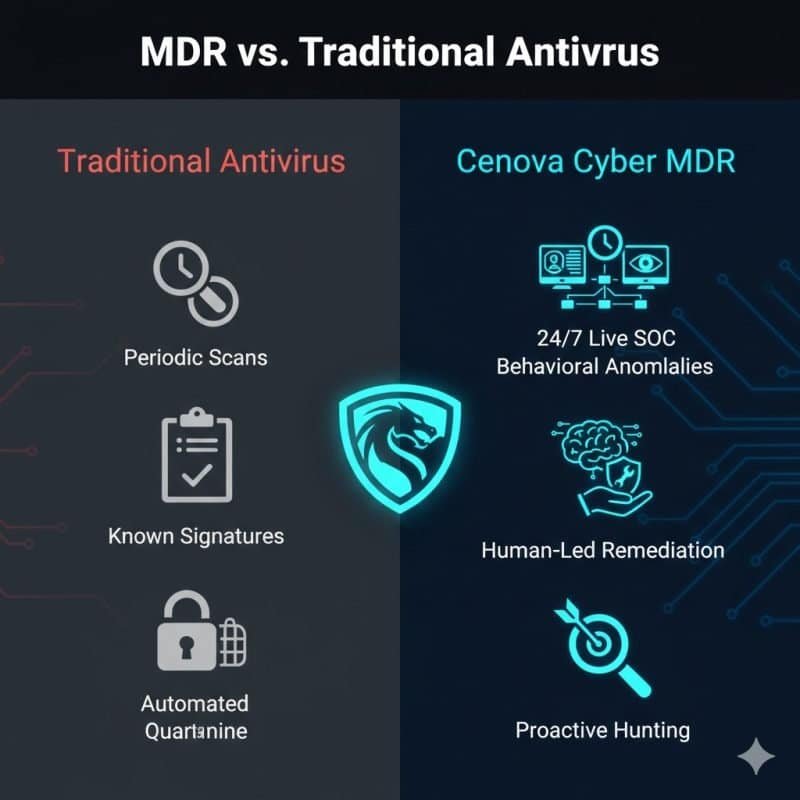
Cenova Cyber’s Managed Detection and Response with SOC service provides continuous monitoring, threat hunting, rapid containment, and compliance-ready reporting. That documentation can help demonstrate that your EDR platform is supported by an active response capability, not left unattended in a dashboard.
3. BACKUPS: CONFIGURATION IS NOT RECOVERY
A backup job that completed successfully does not prove that your business can recover.
Cyber insurers want to see both protected backup architecture and successful restoration testing.
Your evidence binder should contain backup configuration reports showing:
- Backup frequency
- Retention periods
- Systems and data included
- Backup destinations
- Encryption status
- Recovery point objectives
- Recovery time objectives
- Immutable or offline storage configuration
- Administrative access restrictions
- Failed or missed backup jobs
At least one backup copy should be protected from the same compromise that could affect production systems. Depending on your environment, that may involve immutable cloud storage, offline media, air-gapped systems, or another appropriately isolated design.
Most importantly, include a restore-test log from the last 90 days.
A useful restore-test record identifies:
- Date of the test
- Systems and data restored
- Backup source used
- Restoration start and completion times
- Result: passed, partially passed, or failed
- Issues discovered
- Corrective actions
- Person responsible for review
- Date remediation was completed
If the test failed, do not hide it. Document the failure and the corrective action. A transparent remediation record is more defensible than claiming recovery readiness without evidence.
BUILD THE BINDER 60–90 DAYS BEFORE RENEWAL
Starting early gives your team time to identify gaps before they become underwriting problems.
90 DAYS BEFORE RENEWAL
- Confirm the carrier’s current application requirements.
- Identify the requested evidence and document owners.
- Review MFA coverage across email, VPN, RDP, and admin accounts.
- Export the latest EDR or MDR coverage report.
- Review backup configuration and restore-test history.
- Check for unsupported systems, exposed services, and overdue vulnerabilities.
60 DAYS BEFORE RENEWAL
- Correct MFA and endpoint coverage gaps.
- Complete a backup restore test if the previous test is older than 90 days.
- Update your incident response plan.
- Review documented security exceptions.
- Run a vulnerability assessment and begin remediation of high-risk findings.
Cenova Cyber’s Vulnerability Management as a Service combines continuous discovery, risk-based prioritization, remediation coordination, validation scanning, and compliance-ready reporting. These records can support both operational risk reduction and underwriting documentation.

30 DAYS BEFORE RENEWAL
- Lock the evidence set for submission.
- Label every artifact with its date and source.
- Confirm that reports match your current environment.
- Prepare a short executive summary explaining open risks and remediation plans.
- Provide the binder to your broker early enough to resolve questions.
2026 CYBER INSURANCE PROOF BINDER CHECKLIST
Use this checklist as a starting point. Your carrier may require additional materials.
MFA AND IDENTITY
- Entra ID, Okta, or equivalent MFA policy screenshots
- MFA enforcement report showing full user coverage
- Coverage for email, VPN, RDP, and remote access
- Coverage for administrative and privileged accounts
- Legacy authentication controls documented
- Exceptions documented with owners and expiration dates
EDR AND MDR
- EDR coverage report for all workstations
- EDR coverage report for all servers
- Agent health and last check-in status
- Unprotected device remediation records
- MDR agreement or SOC statement of work
- Escalation procedures and response responsibilities
- Recent monitoring or incident summary reports
BACKUPS AND RECOVERY
- Backup frequency and retention configuration
- Protected, immutable, or offline copy evidence
- Backup job success and failure reports
- Restore test completed within the last 90 days
- Systems tested and recovery outcomes documented
- Corrective actions for failed or partial tests
- Recovery objectives and runbook
GOVERNANCE AND RISK
- Current incident response plan
- Security exception register
- Vulnerability and remediation reports
- Patch compliance evidence
- Security awareness training records
- Annual risk assessment or vCISO review
- Evidence retention and document ownership process
GAPS CAN AFFECT MORE THAN YOUR PREMIUM
Failing to maintain a security control can create operational risk, underwriting friction, coverage limitations, or difficult claim discussions.
Policy language matters. If your application states that a control is fully implemented but your environment does not match that representation, the discrepancy may become significant during a claim investigation. Depending on the policy and applicable law, misrepresentation, exclusion language, or failure to meet required conditions could affect coverage.
This is why evidence must remain current after renewal. Your binder is not a one-time submission. It is an ongoing record that your security program operates as represented.
BUILD AN UNDERWRITING-READY SECURITY PROGRAM
Cyber insurance is not a substitute for security. It is one layer of a broader resilience strategy.
We help organizations build the operational controls and documentation needed to reduce exposure, respond faster, recover more confidently, and demonstrate measurable security maturity.
Cenova Cyber can help you prepare through:
- VMaaS for continuous vulnerability discovery, prioritization, remediation tracking, and validation
- MDR and SOC services for 24/7 monitoring, threat hunting, and rapid containment
- vCISO services for security governance, policy development, risk management, and executive reporting
Do not wait for your renewal questionnaire to expose your evidence gaps. Contact Cenova Cyber today to schedule a security and insurance-readiness review. We will help you identify what underwriters are likely to request, organize the proof, and build a more defensible security program.
Your carrier wants evidence. Build it before you need it.