
“We’re Too Small to Be Hacked” Is Dead: Why SMBs Are Now the Preferred Target

For years, “we’re too small to be hacked” sounded like a reasonable assumption.
It is not.
In 2026, attackers do not need to personally select every target. Automated tools scan the internet continuously, identify exposed systems, test stolen credentials, and launch phishing campaigns at scale. If your business has valuable data and one exploitable weakness, it can enter an attacker’s pipeline, regardless of revenue, employee count, or industry.
Small businesses are not overlooked. They are efficient targets.
THE COST OF ATTACK HAS COLLAPSED
Cybercriminals used to need specialized skills, infrastructure, and significant time to attack a business. Today, much of that capability is available through criminal marketplaces and subscription-based services.
Attackers can purchase or rent:
- Ransomware-as-a-service
- Phishing kits and stolen credentials
- Automated vulnerability scanners
- AI-generated emails and social engineering scripts
- Initial access to compromised systems
- Botnets for credential stuffing and distributed attacks
Artificial intelligence makes these operations faster and more convincing. Attackers can research your company, imitate a vendor, personalize a message, and generate follow-up communications in minutes.
The result is a simple economic shift: volume attacks are now profitable.
An attacker does not need to spend weeks targeting one company. They can send thousands of highly convincing messages, scan thousands of internet-facing assets, and wait for a percentage of victims to respond.

YOUR SIZE DOES NOT DETERMINE YOUR VALUE
A 50-person company may hold everything an attacker wants:
- Payment card information
- Bank account details
- Customer and patient records
- Employee identities and tax information
- Proprietary business data
- Email accounts and cloud credentials
- Remote access credentials
- Insurance and financial documents
The business may also have fewer security controls, limited internal expertise, and less time to investigate suspicious activity.
That combination creates an attractive target: valuable information protected by a smaller security budget.
A 2026 Proton SMB Cybersecurity Report found that approximately one in four small and medium-sized businesses experienced a breach during the previous year. The report also found that virtually all affected organizations had at least some security tools in place.
Security tools matter. But tools without monitoring, prioritization, and response leave dangerous gaps.
THE 2026 NUMBERS TELL A CLEAR STORY
The available data does not support complacency.
- Kaspersky reported more than 33,000 attacks against SMB users during the first four months of 2026 that masqueraded as popular artificial intelligence tools, nearly five times the volume recorded during the same period in 2025.
- The same research found these attacks were 39% more common than attacks disguised as office and collaboration tools.
- TotalAssure’s 2026 small-business analysis reported average data-breach losses of approximately $254,445 for North American small businesses.
- The latest IBM Cost of a Data Breach research places the global average breach cost across organizations at approximately $4.99 million. That is not an SMB-specific figure, but it demonstrates the scale of the broader risk.
- The last widely cited IBM size-specific benchmark placed the average breach cost for organizations with fewer than 500 employees at approximately $3.31 million. Because IBM no longer publishes the same size breakout in its current report, this figure should be treated as a historical planning benchmark, not a guaranteed cost.
The practical takeaway is more important than any single statistic:
A serious incident can cost an SMB far more than a year of proactive security.
Downtime, legal support, forensic investigation, customer notification, regulatory requirements, lost revenue, and reputational damage can quickly turn a technical incident into a business continuity crisis.
ATTACKERS ALSO USE SMBs AS A GATEWAY
Your business may not be the final objective.
Attackers increasingly compromise smaller organizations to reach larger partners, customers, vendors, or contractors. If your business has privileged access to another company’s systems, shared files, payment platforms, or data environment, you may be valuable as a connection point.
This is especially important for organizations that:
- Process payments for larger companies
- Provide outsourced professional services
- Connect to customer portals or cloud environments
- Maintain sensitive supply-chain information
- Support healthcare, government, finance, or regulated clients
- Use remote access tools to manage customer systems
A breach at your company can therefore become a supply-chain event. Your customers may evaluate your security posture before signing a contract, renewing an agreement, or allowing access to their environment.
Security is no longer only about protecting your own business. It is also about proving that you are a trustworthy partner.
WHY BASIC SECURITY TOOLS ARE NOT ENOUGH
Antivirus, firewalls, multifactor authentication, and backups remain essential. But they do not create a complete defense by themselves.
The real challenge is what happens after a suspicious event occurs:
- Who sees the alert?
- Who determines whether it is a real threat?
- Who investigates the affected account or device?
- Who contains the incident?
- Who confirms that the attacker is gone?
- Who communicates the risk to leadership?
- Who documents the response for customers, insurers, or regulators?
Most SMBs do not have a dedicated security operations team working around the clock. That is where a managed defense becomes practical.
THE REALISTIC DEFENSE: MDR AND A 24/7 SOC
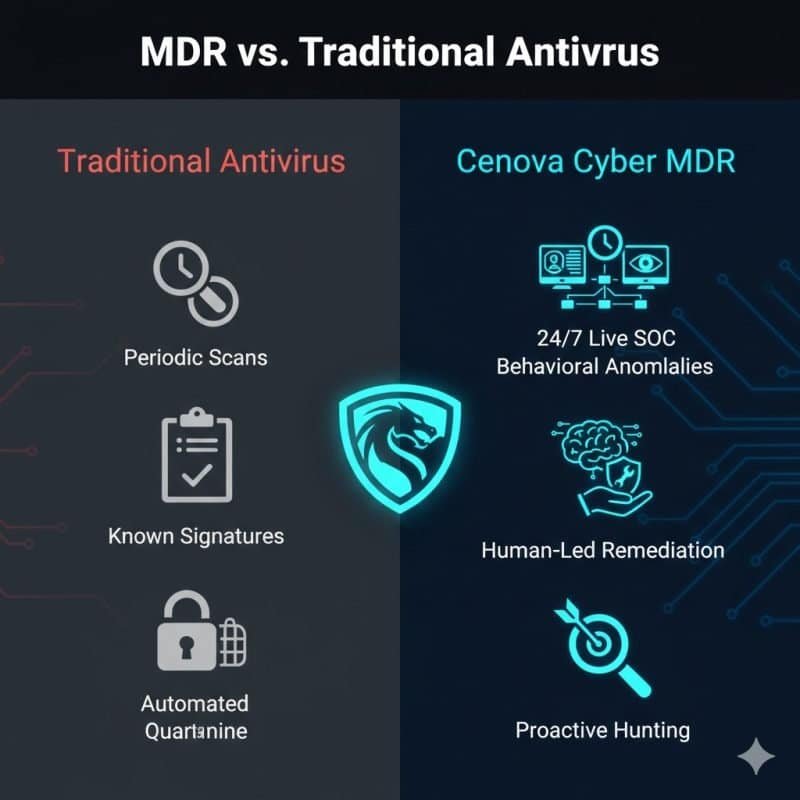
Cenova Cyber’s Managed Detection and Response service combines continuous monitoring with human-led investigation and response.
Our SOC monitors endpoints, networks, and cloud environments around the clock. When suspicious behavior appears, our team investigates the activity, filters false positives, and takes action to contain confirmed threats.
MDR helps your business:
- Detect threats before they become major incidents
- Reduce attacker dwell time
- Investigate unusual account and endpoint behavior
- Isolate compromised devices
- Block malicious activity
- Support incident response and documentation
- Extend your internal IT team without hiring a full security department
This is the difference between receiving an alert and having someone responsible for what happens next.
PREVENT THE EASY BREAK-IN WITH VULNERABILITY MANAGEMENT
Attackers do not need a sophisticated zero-day exploit if an exposed, unpatched vulnerability will work.
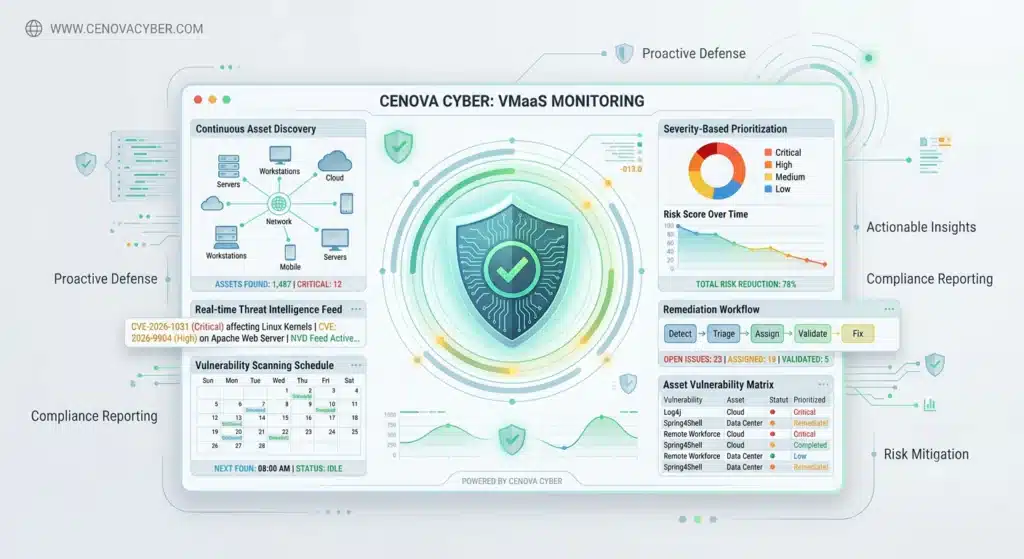
Cenova Cyber’s Vulnerability Management as a Service helps SMBs identify, prioritize, and remediate weaknesses across internal systems, cloud environments, endpoints, applications, and internet-facing assets.
VMaaS goes beyond a periodic scan and a long report. It provides:
- Asset discovery and exposure baselining
- Continuous internal and external scanning
- Risk-based prioritization
- Remediation coordination
- Validation scans
- Compliance-ready reporting
This matters because not every vulnerability deserves the same response. We help your team focus first on what is exploitable, exposed, and connected to critical business operations.
BUILD LEADERSHIP WITH A vCISO
Many SMBs have capable IT professionals but no executive-level cybersecurity leader. That gap creates uncertainty around risk, compliance, insurance, vendor requirements, and long-term priorities.
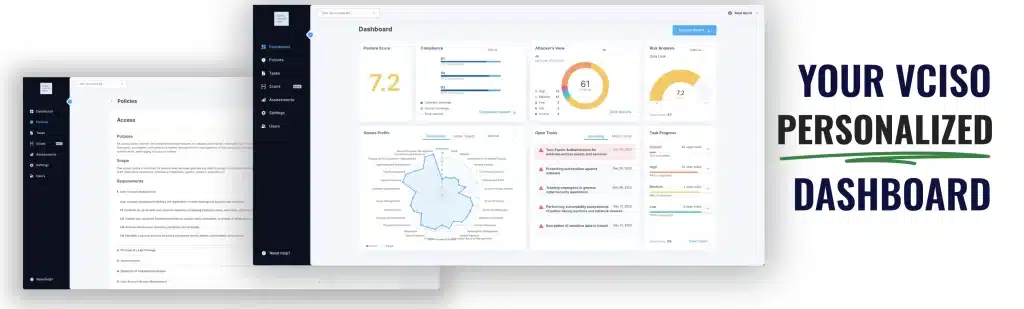
Cenova Cyber’s vCISO services provide experienced security leadership without the cost of hiring a full-time CISO.
A vCISO can help your organization:
- Establish a practical cybersecurity roadmap
- Align security spending with business risk
- Prepare for customer and insurance reviews
- Develop policies and incident response plans
- Support HIPAA, CMMC, SOC 2, PCI DSS, NIST, and other requirements
- Report cybersecurity risk clearly to leadership
- Coordinate testing, remediation, and security improvements
STOP TREATING SIZE AS A SECURITY STRATEGY
Being small is not a defense. Being difficult to compromise, quick to detect threats, and prepared to respond is a defense.
Every SMB should be able to answer “yes” to these questions:
- Do we know what assets are exposed to the internet?
- Are critical vulnerabilities prioritized and remediated?
- Is someone monitoring our environment after business hours?
- Can we contain a compromised endpoint quickly?
- Do leadership and employees understand their security responsibilities?
- Do we have an incident response plan that has been tested?
- Can we demonstrate reasonable security controls to customers and insurers?
If the answer is “not yet,” the next step is not panic. It is a clear, prioritized plan.
GET A FREE SECURITY CONSULTATION
You do not need an enterprise-sized budget to build an enterprise-minded security program.
Cenova Cyber helps SMBs use the right combination of MDR/SOC monitoring, vulnerability management, and vCISO leadership to reduce risk without adding unnecessary complexity.
Schedule a free consultation with Cenova Cyber. We will review your current exposure, identify practical priorities, and help you determine which protections fit your business, budget, and obligations.
Contact Cenova Cyber today for your free security consultation.
The threat landscape has changed.
Your security strategy must change with it.