
MDR vs. SOC as a Service: Which One Actually Stops an Active Breach?

It’s 2:00 AM on a Tuesday. Your phone buzzes on the nightstand: not a text, but a critical alert. An unauthorized user is moving laterally through your network, encrypting files as they go. This is the moment every business owner in Tampa: and across the country: dreads.
In this split second, you don’t need a report. You don’t need a “ticket” that will be reviewed at 9:00 AM. You need the threat stopped. NOW.
We hear the questions every day: “Do I need MDR? Or is SOC as a Service enough?” While the terms are often used interchangeably in the industry, they are fundamentally different tools. One is about watching the fire; the other is about putting it out before the building burns down.
At Cenova Cyber, we help organizations navigate these choices so you can focus on your business: not monitoring logs. Let’s break down the real-world differences between Managed Detection and Response (MDR) and SOC as a Service (SOCaaS).
OUTCOME VS. OPERATIONS – KNOW THE DIFFERENCE
When you look at your security stack in 2026, you have to decide what your primary goal is. Are you looking for a partner to manage the “plumbing” of your security, or are you looking for a guaranteed outcome?
MDR: THE WEAPON OF CHOICE FOR RESPONSE
Managed Detection and Response (MDR) is built for one thing: speed. It is an OUTCOME-BASED service. When a threat hits your endpoint, MDR doesn’t just tell you about it. It acts.
By leveraging advanced AI and expert-led playbooks, MDR can isolate a compromised laptop or kill a malicious process at machine speed. It’s the difference between a smoke detector and a high-speed sprinkler system that activates the moment it senses heat.
Download our AI Governance Guidance for Executives
SOCaaS: YOUR STRATEGIC MISSION CONTROL
SOC as a Service (SOCaaS) is the broader OPERATIONS HUB. It provides the 24/7 visibility, log management, and compliance reporting that many organizations: especially those in regulated industries like healthcare or finance: desperately need.
While SOCaaS detects threats, its primary job is to provide the “big picture.” It’s your mission control center, ensuring that every piece of your digital infrastructure is monitored and that your business remains compliant with frameworks like HIPAA or PCI.
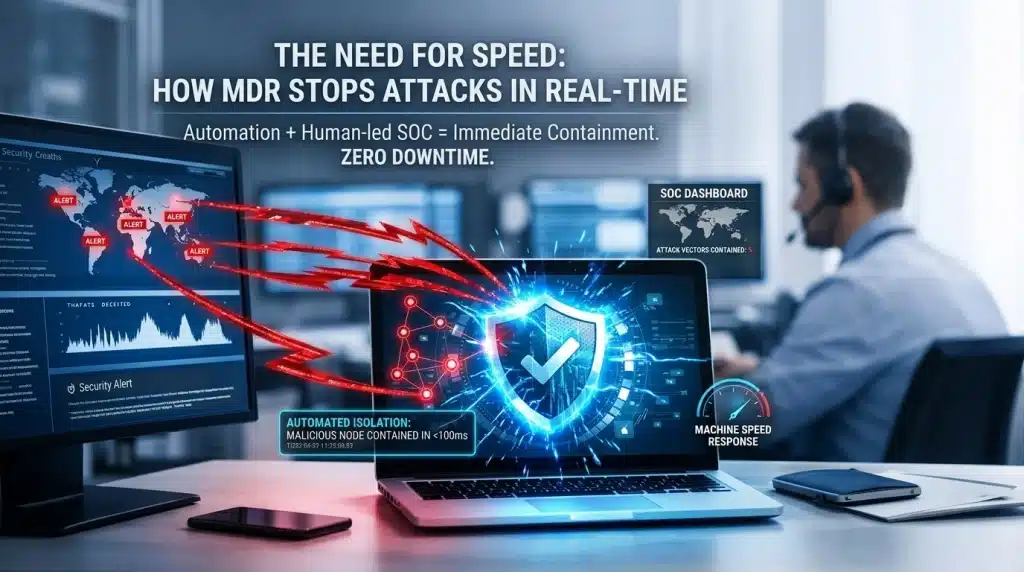
THE MIDNIGHT BREACH: A TALE OF TWO RESPONSES
To understand which one you need, let’s look at how an active ransomware attack plays out under both models.
Scenario A: The SOCaaS Approach
The SOC team detects suspicious activity. They analyze the logs, confirm it’s a breach, and escalate the ticket to your internal IT team. Since it’s 2:00 AM, your IT manager is asleep. By the time they wake up at 6:00 AM and check their email, the hackers have already exfiltrated 50GB of client data. The SOC did its job: it monitored and alerted: but the response depended on you.
Scenario B: The MDR Approach
The MDR platform detects the same suspicious activity. Within milliseconds, an automated playbook triggers. The affected workstation is kicked off the network. The attacker’s connection is severed. Our expert analysts review the event, confirm the threat is neutralized, and send you a summary of the actions already taken when you wake up. The breach was stopped before it could even start.
As we noted in our guide on why your SMB needs MDR in 2026, the difference between these two scenarios is often the difference between a minor blip and a business-ending catastrophe.
WHY THE SOC STILL MATTERS
Don’t get us wrong: SOC as a Service is essential for modern business governance. If you are dealing with Florida’s Digital Bill of Rights or other complex compliance requirements, you need a SOC.
A SOC provides:
- Comprehensive Visibility: It watches everything: not just your computers, but your cloud apps, firewalls, and servers.
- Audit Readiness: When auditors ask for 12 months of logs and evidence of monitoring, the SOC provides the reports.
- Proactive Strategy: It helps identify weak spots in your perimeter before they are exploited.
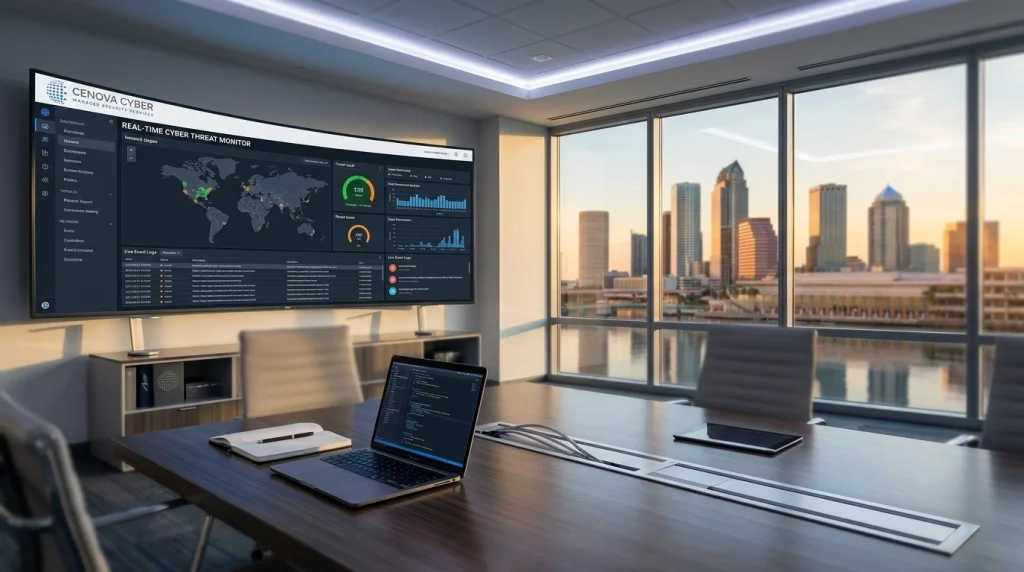
STOP HIRING – START SECURING
Building an internal 24/7 security team is, quite frankly, a budget killer for most organizations. To cover a 24/7/365 schedule properly, you need at least 5 to 6 full-time security analysts. Between salaries, benefits, and the constant training required to keep up with AI-driven phishing, you’re looking at a million-dollar-a-year investment.
By partnering with Cenova Cyber, you get enterprise-grade security without the enterprise-grade price tag. We provide the 24/7 eyes-on-glass monitoring and the rapid-response capabilities you need, allowing you to reallocate those funds into growing your core business.
FOCUS ON YOUR BUSINESS: WE’LL FOCUS ON THE THREATS.

THE CENOVA ADVANTAGE: FINDING YOUR PERFECT MIX
Most of our clients in the Tampa area and nationwide don’t just need one or the other: they need a hybrid approach. You need the SPEED of MDR to stop the hackers and the OVERSIGHT of a SOC to stay compliant and secure.
We don’t believe in “one size fits all” security. Whether you are a 20-person medical clinic or a 1,500-employee manufacturing firm, we right-size the solution to your specific risk profile.
OUR PROMISE TO YOU:
- NO MORE ALERT FATIGUE: We only tell you when it’s real.
- HASSLE-FREE COMPLIANCE: We handle the logs; you get the certificates.
- PROVEN EXPERTISE: Over two decades of experience keeping businesses safe.
If you’re still trying to decide between managed security vs. in-house IT, or if you aren’t sure how your current setup would handle an active breach, let’s talk.

TAKE THE FIRST STEP TOWARD RESILIENCE
Don’t wait for the 2:00 AM phone call to find out if your security works. Let us provide a comprehensive assessment of your current environment and show you how a combined MDR and SOCaaS strategy can protect your future.
TRUSTED SOLUTIONS – PROVEN RESULTS
Contact Cenova Cyber Today for a Free Security Assessment.
Get Started Here