
AI in Security & Compliance Audits: Where Automation Helps – and Where It Can Go Wrong
Artificial intelligence has become deeply embedded in cybersecurity and compliance workflows. From log analysis and control mapping to evidence collection and continuous monitoring, AI‑driven tools promise faster audits, lower costs, and reduced administrative burden.
But recent events in the compliance automation market have exposed an uncomfortable truth: when AI is misapplied, poorly governed, or treated as a substitute for professional judgment, it can introduce significant compliance, security, and legal risk instead of reducing it. [compliancehub.wiki], [techcrunch.com]
Using those events as a reference point, this article explores the real advantages and real risks of relying on AI tools for security and compliance audits – and how organizations should approach their use responsibly.
The Upside: Why AI Has a Legitimate Role in Audits
When used correctly, AI can dramatically improve the efficiency and consistency of compliance programs.
1. Faster Evidence Collection and Normalization
Modern security and compliance audits require data from dozens of systems – endpoint tools, cloud platforms, ticketing systems, IAM providers, and policies. AI excels at aggregating, normalizing, and categorizing large volumes of evidence, reducing weeks of manual work into days or hours. [compliancehub.wiki]
This is especially valuable for frameworks like SOC 2, ISO 27001, HIPAA, and CMMC, where ongoing evidence maintenance – not the audit itself – is the biggest operational burden.
2. Continuous Monitoring Instead of Annual Scrambles
Traditional audits often create a once‑a‑year compliance surge. AI‑enabled platforms can support continuous control monitoring, alerting teams when controls drift or evidence becomes stale – improving both security posture and audit readiness. [axipro.co]
3. Improved Standardization Across Controls
AI systems are effective at mapping controls across frameworks, reducing redundant work when organizations pursue multiple standards (e.g., SOC 2 + ISO 27001). This cross‑framework normalization is a genuine productivity gain that improves consistency and reduces human error. [axipro.co]
The Downside: Where AI‑Driven Audits Become Dangerous
The risks emerge when AI tools move from assistance into authority – especially when human oversight is minimized or removed.
1. Automation Can Result In the Illusion of Compliance
Recent investigations revealed AI‑driven platforms allegedly generating identical audit reports, pre‑written conclusions, and fabricated evidence – creating what experts have called “compliance theater” rather than real assurance. [compliancehub.wiki],[byteiota.com]
AI is remarkably good at producing plausible documentation. That is precisely the risk. Without independent verification, plausible documentation can be mistaken for validated controls.
2. Auditor Independence Cannot Be Automated
Security audits – especially SOC 2 – depend on independent professional judgment. AI cannot replace:
- Auditor skepticism
- Evidence validation
- Contextual assessment of exceptions
- Independence requirements under AICPA standards
When AI tools generate findings or conclusions before evidence is evaluated, they undermine the very principle audits are designed to uphold. [compliancehub.wiki]
3. Legal and Regulatory Exposure Shifts to the Customer
When an AI‑driven audit fails scrutiny, regulators don’t fine the software vendor – they fine the organization that presented the report. Customers relying on flawed AI‑based certifications may face regulatory penalties, contract disputes, insurance denials, or false claims exposure. [techcrunch.com], [economictimes.com]
In highly regulated environments, reliance on unverified AI output can convert a perceived compliance shortcut into material legal risk. For example, DoD contractors, relying on ‘fabricated’ AI evidence isn’t just a business risk – it’s a potential violation of the False Claims Act, which the DOJ is now aggressively prosecuting.
The Core Lesson: AI Is a Tool – Not a Control Owner
The most important takeaway from recent events is not “avoid AI.” It is understand its role.
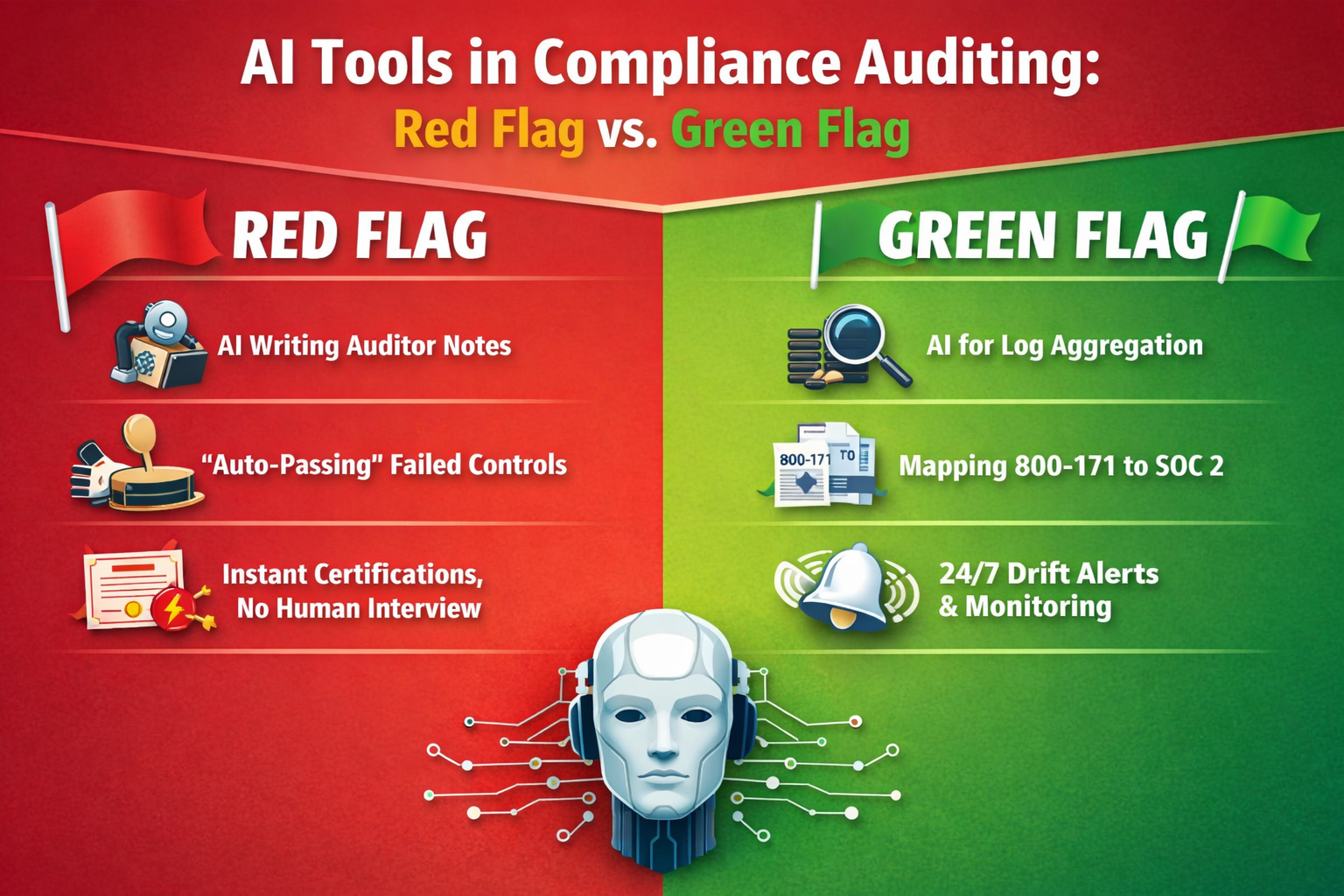
AI should:
- Assist with evidence collection
- Highlight gaps and anomalies
- Improve monitoring and reporting
AI should not:
- Declare compliance
- Replace auditor judgment
- Fabricate or infer unverified controls
- Stand between the organization and independent verification
When organizations – or vendors – allow AI to author compliance outcomes instead of supporting them, the model breaks down. [compliancehub.wiki]
How Organizations Should Use AI Safely in Audits
To realize the benefits of AI without inheriting its risks, organizations should follow four principles:
- Human-in-the-Loop Governance
Every AI‑assisted audit workflow must retain explicit human review and sign‑off at decision points. - Clear Role Separation
Tools collect and organize evidence. Auditors validate and conclude. When that line blurs, compliance fails. - Transparency Over Speed
Faster audits are irrelevant if they are not defensible. Executives should prioritize verifiability over velocity. - Vendor Accountability and Scope Clarity
Organizations must understand exactly what their compliance tools do – and what they do not do – to avoid misplaced trust. [axipro.co]
Conclusion: Responsible AI Strengthens Compliance – Unchecked AI Endangers It
AI has a legitimate and valuable place in security and compliance programs. Used thoughtfully, it reduces overhead, improves visibility, and supports continuous assurance.
But recent market failures make one fact clear: AI does not eliminate the need for professional judgment, independence, or accountability. In compliance, credibility matters more than convenience.
The future of audits is not end-to-end automation. Organizations must look for partners who use technology to surface truth, not to manufacture consensus. The use of AI in compliance is augmented intelligence, governed responsibly.
Sources
- ComplianceHub – The Delve Scandal: When Your SOC 2 Report Is Just a Template [compliancehub.wiki]
- TechCrunch – Delve accused of misleading customers with ‘fake compliance’ [techcrunch.com]
- ByteIota – Delve Compliance Fraud: $32M Startup Faked 494 SOC 2 Audits [byteiota.com]
Note – Cenova Cyber is not a law firm and this article is not legal advice.
Download our AI Governance Guidance for Executives
Whether you need a full-scale Managed IT solution or a strategic Risk Management overhaul, we are here to help. Let’s move your business from a “Break-Fix” headache to a “Hassle-Free” future.
Contact Cenova Cyber Today for a comprehensive IT health check and see how we can turn your IT from an expense into your greatest asset.