
Why Your Monthly Vulnerability Scan Is Failing You: The Rise of VMaaS in 2026
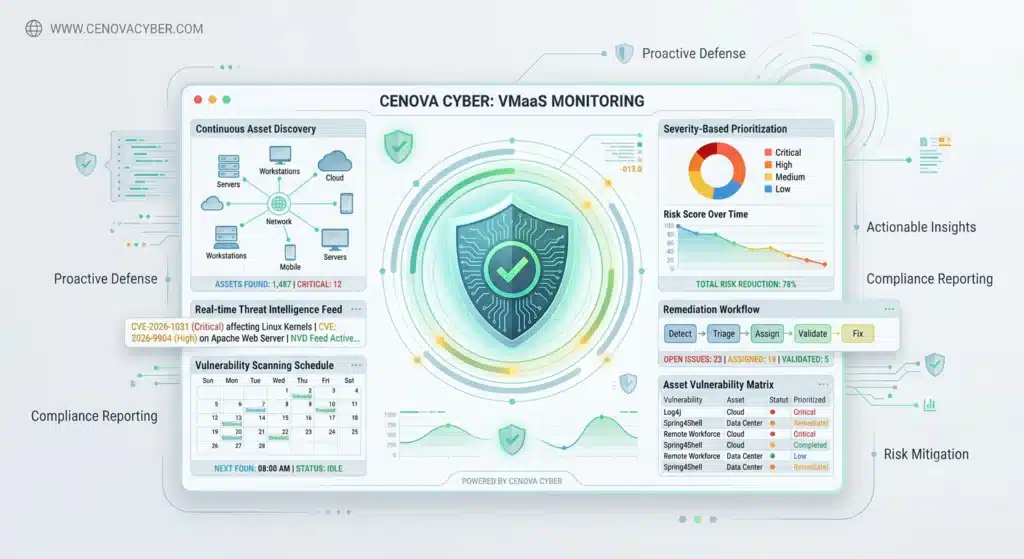
A monthly vulnerability scan can tell you what was exposed on the day it ran. It cannot tell you what changed yesterday, which vulnerability attackers are actively exploiting, or whether your most important systems remain misconfigured today.
That gap is becoming a serious business risk.
According to Verizon’s 2026 Data Breach Investigations Report, exploitation of software vulnerabilities is now the leading initial access vector, accounting for 31% of breaches. Vulnerability exploitation has overtaken credential abuse as the most common way attackers gain entry.
The same report found that the median time to fully resolve critical vulnerabilities increased to 43 days, up from 32 days the previous year. Only 26% of critical vulnerabilities: those listed in CISA’s Known Exploited Vulnerabilities Catalog: were fully remediated during the reporting period.
The message is direct: finding vulnerabilities is not the same as managing them.
THE PROBLEM WITH SCAN-AND-DUMP SECURITY
Traditional vulnerability scanning remains useful. The problem is relying on a scan, a spreadsheet, and a PDF report as the complete vulnerability management program.
A typical scan-and-dump process looks like this:
- A scanner checks the environment at a scheduled time.
- The tool generates a long list of findings.
- Vulnerabilities are ranked primarily by CVSS severity.
- An IT team receives the report and is expected to determine what matters.
- Remediation is handled manually: if time and resources are available.
- A later scan attempts to confirm whether the issue was resolved.
This process creates predictable weaknesses:
- New devices and cloud workloads may remain undiscovered.
- Internet-facing systems can change between scan cycles.
- Critical patches may be delayed because teams cannot safely patch everything at once.
- Misconfigurations can persist even when software is fully updated.
- Reports may contain thousands of findings but provide little business context.
- There is often no owner, deadline, ticket, or validation step tied to a finding.
A report can document exposure without reducing it.
For SMBs, this becomes a staffing problem. For healthcare organizations and government contractors, it becomes a compliance and operational risk. In both cases, vulnerabilities remain open while attackers continue scanning the same environments.
THE 2026 VULNERABILITY LANDSCAPE REQUIRES A FASTER RESPONSE
The 2026 DBIR makes clear that attackers are increasingly targeting systems rather than relying exclusively on stolen credentials or social engineering.
That shift is not surprising. Unpatched internet-facing applications, remote access systems, edge devices, cloud services, and business platforms give attackers a direct path into an organization. A single missed update or improperly configured service can become the first step in a ransomware deployment or data theft operation.
Patching delays increase that exposure window.
A 43-day median resolution time means a known critical vulnerability may remain available to attackers for more than six weeks. During that period, the organization may already know about the weakness: but still lack the prioritization, coordination, or technical capacity to close it.
Misconfigurations create a similar problem. The 2026 DBIR reported that weak passwords and permission misconfigurations took almost eight months to resolve in half of the findings it analyzed. These are not theoretical weaknesses. They are operational conditions that can remain active long after they are identified.
Security teams need more than severity scores. They need to know:
- Is the vulnerability being exploited in the wild?
- Is the affected asset exposed to the internet?
- Does it support critical business operations?
- Does it store regulated or sensitive information?
- Is the system connected to Active Directory, cloud infrastructure, or other high-value assets?
- Can the issue be patched, isolated, reconfigured, or mitigated?
- Has remediation actually been validated?
That is the difference between vulnerability scanning and vulnerability management.
WHAT IS VULNERABILITY MANAGEMENT AS A SERVICE?
Vulnerability Management as a Service: VMaaS: combines discovery, scanning, prioritization, remediation coordination, and validation into an ongoing security program.
At Cenova Cyber, our VMaaS approach is designed to close the gap between identifying a weakness and fixing the risk it creates.
The service includes:
1. CONTINUOUS ASSET DISCOVERY
We identify endpoints, servers, cloud workloads, internet-facing assets, Active Directory resources, and other systems across your environment.
This helps uncover shadow IT, unmanaged devices, forgotten systems, and new assets that may not appear in a static inventory. You cannot protect what you do not know exists.
2. INTERNAL AND EXTERNAL SCANNING
Cenova Cyber performs recurring vulnerability assessments across internal networks, external attack surfaces, cloud environments, Microsoft 365, Active Directory, and web applications.
Scan schedules are tailored to your risk profile and compliance requirements. Internet-facing and critical assets may require more frequent attention than lower-risk systems.
3. RISK-BASED PRIORITIZATION
Not every vulnerability deserves the same response on the same day.
Our team uses exploit-probability intelligence, including EPSS, alongside asset criticality and business context. We also consider indicators such as:
- Active exploitation
- CISA KEV catalog status
- Internet exposure
- Sensitive data access
- Business impact
- System dependencies
- Available patches or compensating controls
This creates a prioritized risk register rather than an overwhelming list of CVEs.

FROM FINDINGS TO FIXES: GUIDED REMEDIATION
A vulnerability management program must produce measurable risk reduction. That requires action after detection.
Cenova Cyber provides hands-on guided and coordinated remediation. We work with your team to assign owners, coordinate patching, track progress, and manage exceptions when immediate remediation is not possible.
Our technology stack supports the full lifecycle:
- ConnectSecure provides internal, external, cloud, and Active Directory vulnerability scanning, EPSS-based exploit prediction, and compliance mapping.
- NinjaOne provides endpoint visibility, patch deployment, and remediation tracking across managed devices.
- Continuous synchronization with vulnerability intelligence sources helps map new CVEs to affected assets as quickly as possible.
The goal is not to force every organization into the same patching schedule. The goal is to fix the vulnerabilities that create the greatest business risk: without disrupting essential operations.
That may mean:
- Applying a security update.
- Removing an exposed service.
- Correcting permissions.
- Reconfiguring a firewall or cloud resource.
- Isolating a vulnerable system.
- Replacing unsupported software.
- Implementing a compensating control.
- Validating that the issue is fully closed.
A vulnerability is not remediated because a ticket says “complete.” It is remediated when the change is verified.
WHY VMaaS MATTERS FOR HEALTHCARE, SMBs, AND CMMC ORGANIZATIONS
HEALTHCARE ORGANIZATIONS
Healthcare systems manage sensitive patient information while depending on a large technology footprint. Medical devices, clinical applications, remote access systems, cloud platforms, and third-party services can all introduce exposure.
VMaaS supports ongoing visibility and documentation aligned with HIPAA, NIST, and other security expectations: so your team can reduce risk without diverting clinical and operational resources.
SMALL AND MID-SIZED BUSINESSES
Most SMBs do not have a dedicated vulnerability management team. Internal IT staff are already responsible for users, infrastructure, cloud services, backups, projects, and day-to-day support.
VMaaS adds specialized expertise and repeatable processes without requiring you to build an entire program in-house. Your staff receive prioritized work instead of another report to interpret.
CMMC AND NIST 800-171 ORGANIZATIONS
Government contractors must demonstrate that security controls are implemented and maintained. Vulnerability management supports the continuous monitoring, patching, configuration management, and evidence requirements associated with CMMC compliance and NIST SP 800-171.
The program also produces documentation that can support audits, cyber insurance reviews, and executive reporting.
TRADITIONAL SCANNING VS. VMaaS
The distinction is simple: traditional scanning tells you what may be wrong. VMaaS helps you decide what to do next: and confirms that the work was completed.
STOP WAITING FOR THE NEXT REPORT
Attackers do not wait for your next monthly scan. They continuously search for exposed systems, unpatched software, weak permissions, and improperly configured services.
Your vulnerability management program must operate at the same speed.
Cenova Cyber’s Vulnerability Management as a Service combines continuous discovery, risk-based prioritization, and guided remediation so you can reduce exposure, support compliance, and keep your business moving.
Book a free Vulnerability Management consultation today. In 20 minutes, we can discuss your current scanning process, patching delays, compliance requirements, and the steps needed to establish a more effective vulnerability management program.
Schedule your free consultation with Cenova Cyber or contact our team.