
AI Made Your Small Business Worth Attacking: The 2026 Threat Landscape Every Owner Needs to See
“We’re too small to be hacked.”
That assumption no longer protects anyone.
In 2026, artificial intelligence has changed the economics of cybercrime. Attackers can research your business, personalize convincing messages, identify exposed systems, and deploy ransomware with less time, less expertise, and less cost than ever before.
Your company does not need to be famous to become a target. It only needs valuable data, accessible accounts, exposed technology, or an employee who can be deceived.
The result is clear: small and midsize businesses are now attractive targets because they are connected, valuable, and often operating without a dedicated security team.
If your business relies on email, cloud applications, remote access, online payments, or customer data, attackers already have multiple ways to reach you.
Schedule a free security consultation with Cenova Cyber.
THE COST OF ATTACKING YOUR BUSINESS HAS COLLAPSED
Cyberattacks once required specialized technical skill, significant infrastructure, and weeks of preparation. AI is removing many of those barriers.
Threat actors can now use AI to:
- Write convincing phishing and business email compromise messages
- Translate and localize scams for different employees and regions
- Study public information about your company and leadership
- Identify exposed systems, services, and cloud assets
- Generate malicious code and automate repetitive attack tasks
- Analyze stolen data for payment, payroll, or operational information
- Support ransomware operations through repeatable criminal platforms
The World Economic Forum’s Global Cybersecurity Outlook 2026 identifies AI as the most significant driver of change in cybersecurity, according to 94% of survey respondents. The same report states that 87% of respondents identified AI-related vulnerabilities as the fastest-growing cyber risk during 2025.
This is not a distant prediction. It is a shift already underway.
Check Point Research has documented criminal operations using commercial AI tools to assist with exploitation, network mapping, data analysis, and mass compromise. The technology is no longer limited to advanced nation-state operations. It is becoming part of the everyday criminal toolkit.
AI-POWERED PHISHING MAKES “COMMON SENSE” LESS RELIABLE
Phishing remains one of the most effective ways to gain access to a business. AI makes it faster, more personalized, and more difficult to recognize.
A generic email filled with spelling mistakes may still be easy to spot. An AI-assisted attack can be very different. It may:
- Match the writing style of a real executive
- Reference an actual customer, vendor, or project
- Use information gathered from LinkedIn or your company website
- Create a realistic invoice or payment request
- Impersonate a supplier, employee, or business partner
- Apply pressure using a believable deadline
- Follow up through email, text message, or voice call
Attackers do not need to fool every employee. They only need one successful interaction.
That interaction might involve a stolen password, a fraudulent wire transfer, a malicious attachment, or approval of an attacker-controlled login. Once inside, the attacker can use legitimate credentials and trusted applications to move quietly.
The World Economic Forum reports that 77% of respondents saw an increase in cyber-enabled fraud and phishing, while 73% reported that they or someone in their professional or personal network had been affected by cyber-enabled fraud.
Security awareness remains important. But awareness alone is no longer enough. Employees cannot be expected to identify every message crafted by tools designed to imitate trusted people and legitimate business activity.
AI-DRIVEN RECONNAISSANCE FINDS YOUR WEAK POINTS FASTER
Before launching an attack, criminals need to understand your environment. Traditionally, reconnaissance required manual research and technical effort.
AI accelerates that process.
Automated tools can help attackers identify:
- Internet-facing servers and remote access systems
- Unpatched applications and vulnerable services
- Misconfigured cloud resources
- Exposed credentials and forgotten accounts
- Publicly visible employee and vendor relationships
- Technology platforms used by your organization
- Weaknesses in third-party integrations
The 2026 security predictions from Trend Micro describe attackers using AI to automate reconnaissance, create highly convincing phishing lures, and map networks with greater accuracy.
For an SMB, that means a forgotten VPN, outdated firewall, exposed administrative portal, or poorly secured cloud account can be discovered quickly.
Security through obscurity is not a strategy. If a system is connected to the internet, assume it will eventually be scanned.
RANSOMWARE-AS-A-SERVICE TURNS CRIMINAL CAPABILITY INTO A SUBSCRIPTION
Ransomware has also become more industrialized.
Ransomware-as-a-service, or RaaS, allows criminal affiliates to purchase or rent access to malware, infrastructure, negotiation support, and attack tools. The person launching the attack does not need to develop the ransomware themselves.
AI strengthens this model by helping attackers automate research, identify valuable data, adjust communications, and move through portions of the attack chain.
The Trend Micro 2026 threat predictions warn that AI-powered RaaS will lower the barrier to entry and enable smaller, faster, and more unpredictable attacks.
For business owners, ransomware is not simply an IT problem. It can interrupt:
- Customer service
- Payroll and accounting
- Production and fulfillment
- Scheduling and communications
- Access to critical files
- Regulatory and contractual obligations
- Customer trust and business reputation
The most damaging moment is not always encryption. It is the loss of operational control that follows.
WHY BASIC ANTIVIRUS IS NOT A COMPLETE DEFENSE
Antivirus, firewalls, and multifactor authentication remain important controls. We recommend them. But they do not provide complete protection against modern, identity-driven attacks.
A determined attacker may use valid credentials, approved applications, cloud services, and ordinary administrative tools. That activity can look normal in isolation.
The difference is context.
Effective defense requires the ability to connect events across users, devices, identities, cloud systems, and network activity. It requires someone: or something: watching for patterns that indicate compromise.
Your team needs to know:
- Is this login normal for this user?
- Why is this employee accessing sensitive data at an unusual time?
- Did a new mailbox rule appear after a suspicious login?
- Is an endpoint communicating with a known malicious destination?
- Are multiple small alerts connected to the same attack?
- Has an attacker moved from one system to another?
If no one is reviewing those signals, the business may discover the attack only after data is stolen or systems are unavailable.
THE REALISTIC DEFENSE FOR SMBs: MDR WITH A 24/7 SOC
Most SMBs do not need to build a 24/7 security operations center internally. That would require specialized personnel, processes, technology, and continuous coverage.
They do need access to those capabilities.
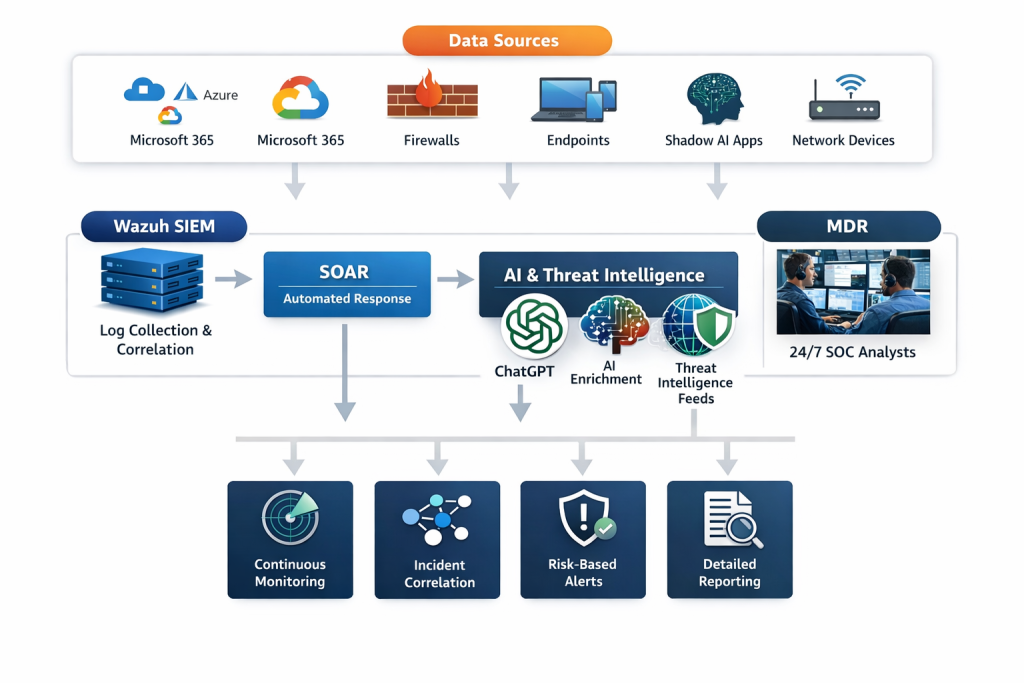
Cenova Cyber’s Managed Detection and Response service combines a 24/7 SOC, threat hunting, behavioral analytics, incident response, and remediation support.
Our team helps businesses:
- Monitor endpoints, networks, and cloud environments around the clock
- Investigate suspicious activity instead of forwarding raw alerts
- Reduce alert fatigue and focus on business-impacting threats
- Isolate infected devices and block malicious activity
- Identify attackers who bypass traditional security tools
- Produce compliance-ready incident and forensic reporting
MDR is not about creating more noise. It is about turning security data into decisions and action.
When a threat appears at 3:00 a.m., your business should not have to wait until morning to respond.
TECHNOLOGY NEEDS LEADERSHIP : NOT JUST MORE TOOLS
Technology alone cannot define your security priorities.
Your organization also needs a plan for managing risk, assigning responsibility, meeting customer expectations, preparing for incidents, and communicating clearly with leadership.
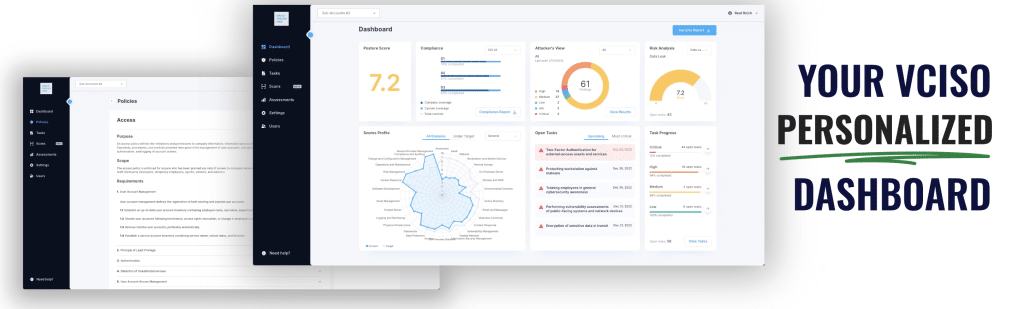
Cenova Cyber’s vCISO services provide executive-level cybersecurity leadership without the cost of hiring a full-time CISO.
A vCISO can help your organization:
- Build a practical cybersecurity roadmap
- Prioritize risks based on business impact
- Establish policies and governance
- Prepare for compliance and cyber insurance requirements
- Plan and exercise incident response
- Report cybersecurity risk to executives and boards
- Align security investments with business objectives
- Coordinate remediation across internal teams and providers
MDR helps detect and respond to threats. vCISO services help ensure your organization is prepared to manage risk before, during, and after an incident.
Together, they give SMB leaders both operational coverage and strategic direction.
A 2026 SECURITY CHECKLIST FOR BUSINESS OWNERS
You do not need to solve every security problem at once. Start with the controls that reduce the most risk:
- Protect identity. Use phishing-resistant multifactor authentication for privileged and sensitive accounts.
- Secure email. Strengthen email filtering and implement SPF, DKIM, and DMARC.
- Know your exposure. Inventory internet-facing systems, remote access tools, cloud services, and third-party connections.
- Patch aggressively. Prioritize VPNs, firewalls, remote access platforms, internet-facing applications, and critical software.
- Monitor continuously. Use MDR or a managed SOC if your team cannot provide 24/7 coverage.
- Protect recovery. Maintain tested, offline or immutable backups using a documented recovery process.
- Prepare leadership. Create an incident response plan and conduct tabletop exercises.
- Govern AI use. Define what company, customer, financial, and confidential data employees may enter into AI tools.
- Review vendors. Understand how providers access, store, protect, and recover your data.
- Measure progress. Use a risk-based roadmap instead of purchasing disconnected tools without accountability.
THE “TOO SMALL TO HACK” ASSUMPTION IS DEAD
Attackers are not always choosing targets manually. Automated systems can find businesses, profile their technology, craft convincing messages, and identify weaknesses at scale.
Your company may be targeted because it is connected to a larger customer. It may be targeted because it processes payments. It may be targeted because an employee has access to valuable systems. Or it may simply be discovered by an automated scan.
That is why the right question is not, “Why would anyone attack us?”
The right question is:
“If an attacker targets us today, how quickly can we detect, contain, and recover?”
Cenova Cyber helps SMBs answer that question with confidence. Our 24/7 MDR and SOC services provide the visibility and response capability modern businesses need. Our vCISO team provides the leadership required to reduce risk and build resilience.
Do not wait for a crisis to discover the gaps in your defenses. Contact Cenova Cyber today for a free consultation.