
If you’re running a business in Florida, you’ve likely heard whispers about the Florida Digital Bill of Rights (FDBR): and maybe you’ve assumed it doesn’t apply to you. After all, the law primarily targets tech giants with revenues exceeding $1 billion.
Here’s the reality: You should care anyway.
Since the FDBR took effect, we’ve watched Florida’s data privacy landscape transform. The law hasn’t just changed how big tech operates: it’s established a gold standard for data handling that’s reshaping expectations across the board. Customers, partners, and regulators increasingly expect FDBR-level data protection from businesses of all sizes.
As a managed security service provider with deep roots in Florida, we’ve helped dozens of organizations navigate this shift. Let’s break down what data sovereignty actually means under FDBR: and why your cybersecurity strategy needs to evolve.

WHAT DATA SOVEREIGNTY REALLY MEANS
Data sovereignty used to be simple: if you collected data, you owned it. Do what you want with it (within reason).
The FDBR flipped that script entirely.
Under this framework, data sovereignty has shifted from businesses to consumers. Florida residents now have explicit, enforceable rights over their personal information: including the ability to access it, correct it, delete it, and restrict how you use it.
Think of it this way: You’re no longer the owner of customer data. You’re the custodian. And custodians have responsibilities.
This isn’t just semantic. It fundamentally changes how businesses must approach data collection, storage, processing, and security. Even if your company falls below the $1 billion threshold, adopting these principles demonstrates commitment to customer privacy: and provides a competitive advantage as data protection becomes table stakes.
THE CORE PRINCIPLES EVERY BUSINESS SHOULD ADOPT
While the FDBR technically applies to large tech platforms, its principles have become the framework smart businesses follow. Here’s what matters most:
DATA MINIMIZATION
Collect only what you actually need. Store it only as long as necessary. Use it only for the purposes disclosed.
This isn’t just good ethics: it’s good security. The less sensitive data you maintain, the smaller your attack surface and the lower your breach risk. Every piece of unnecessary customer data is a liability waiting to happen.
TRANSPARENCY REQUIREMENTS
Customers deserve to know what you’re collecting, why you’re collecting it, how you’re using it, and who else gets access to it.
Create clear, accessible privacy policies. Make them actually readable: not 40 pages of legal jargon. Explain data practices in plain language. Disclose third-party data sharing explicitly. We also recommend writing your policies for your ‘To Be’ state and then documenting any gaps in your risk register. Then, track and work to correct the issue. We’ve seen many organizations that only include what they are currently doing in their policies, but then never find the time to address the security gap because ‘it’s not policy.’
Transparency builds trust. And in 2026, trust is currency.

CONSENT AND OPT-OUT PROTECTIONS
Here’s where things get practical: consumers must be able to say no.
The FDBR requires businesses to obtain prior consent before processing sensitive personal data or information about minors. It also grants consumers the right to opt out of data sales, targeted advertising, profiling, and collection through voice or facial recognition.
Even if you’re not legally required to implement these controls, consider doing it anyway. Giving customers control over their data isn’t just compliance: it’s customer service.
SECURITY STANDARDS
Perhaps most critical: you must implement technical, administrative, and physical security controls commensurate with the data you handle.
This is where many businesses stumble. Security isn’t a one-time project or a checkbox. It’s an ongoing discipline that requires expertise, monitoring, and adaptation.
As threats evolve, so must your defenses. That’s exactly why organizations increasingly partner with managed cybersecurity services providers rather than attempting to build capabilities in-house.
ENFORCEMENT IN 2026: WHAT WE’RE SEEING
Two years into FDBR enforcement, patterns have emerged.
The Florida Department of Legal Affairs isn’t messing around. We’ve seen civil penalties up to $50,000 per violation: and those penalties triple for violations involving minors, failure to honor deletion requests, or continuing to sell data after consumers opt out.
Do the math on a data breach affecting thousands of customers. The financial exposure becomes staggering fast.
More importantly, we’re seeing enforcement action expand beyond obvious violators. Regulators are examining data handling practices across industries, investigating consumer complaints, and imposing penalties on businesses that demonstrate negligent security practices.
The message is clear: Data protection isn’t optional anymore.
WHY SMBS AND MID-MARKET COMPANIES SHOULD PAY ATTENTION
“But Michael,” you might say, “we’re not Facebook. We don’t have a billion-dollar revenue. Why does this matter to us?”
Three reasons:
First, customer expectations have changed. B2B buyers and consumers alike expect FDBR-level data protection. If you can’t demonstrate robust privacy practices, you’ll lose deals to competitors who can.
Second, your business partners care. If you’re in a supply chain or partnership ecosystem with larger organizations, they’ll require you to meet their security standards: which increasingly align with FDBR principles.
Third, proactive compliance protects you. Laws evolve. Thresholds change. By adopting these principles now, you future-proof your business against regulatory expansion.
And here’s the kicker: Implementing these practices doesn’t require massive resources. With the right cybersecurity consulting partner and modern managed security tools, even smaller organizations can achieve enterprise-grade data protection.
THE SECURITY IMPLICATIONS YOU CAN’T IGNORE
Data sovereignty requirements directly impact your security posture. Here’s how:
You need visibility. You can’t protect data you don’t know you have. Comprehensive cybersecurity risk assessments identify what sensitive information you’re collecting, where it lives, who has access, and how it’s protected.
You need monitoring. Data breaches don’t announce themselves. Managed detection and response services provide 24/7 monitoring, threat hunting, and incident response capabilities that detect and contain threats before they become disasters.
You need governance. Security isn’t just technology: it’s policies, procedures, training, and accountability. You need frameworks that ensure consistent, compliant data handling across your organization.
You need expertise. The cybersecurity skills shortage is real. Building an in-house team capable of implementing FDBR-aligned security controls is expensive and time-consuming. Partnering with a managed security service provider gives you immediate access to specialized expertise without the overhead.

HOW TO PREPARE: PRACTICAL STEPS
If you’re ready to align your practices with Florida’s data sovereignty framework, here’s your roadmap:
1. Conduct a Data Inventory
Document what personal data you collect, where it’s stored, how it’s processed, and who has access. You can’t protect what you don’t understand.
2. Perform a Gap Analysis
Compare your current practices against FDBR principles. Where do you fall short? What vulnerabilities exist?
A comprehensive cybersecurity risk assessment identifies these gaps and prioritizes remediation based on actual business risk.
3. Implement Technical Controls
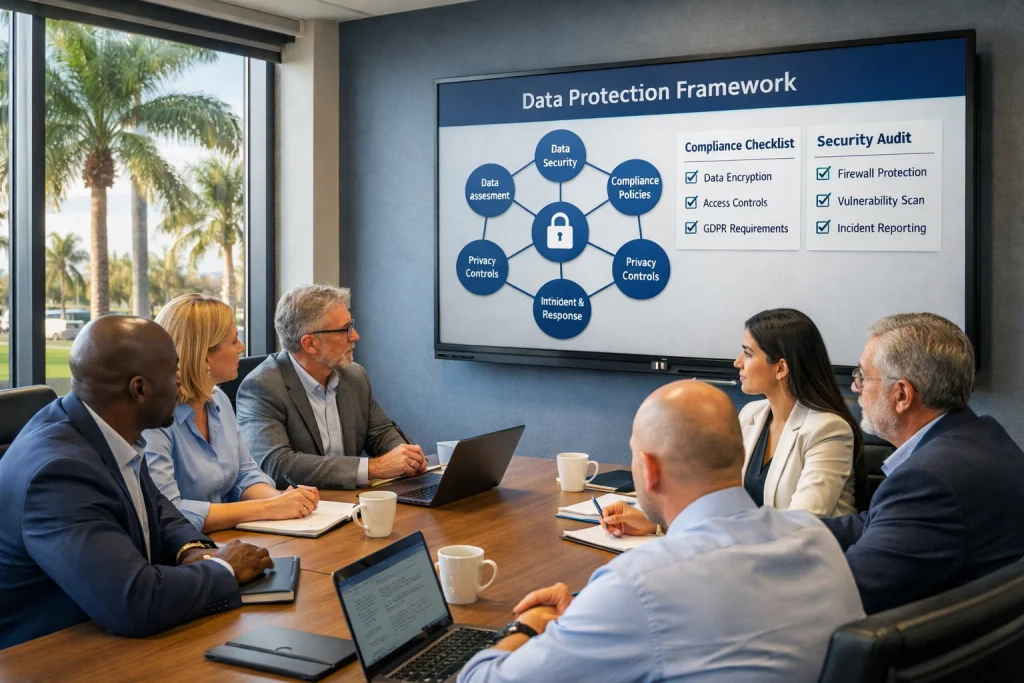
Deploy encryption for data at rest and in transit. Implement access controls and multi-factor authentication. Establish logging and monitoring. Segment networks to limit breach impact.
Modern managed cybersecurity services platforms handle this complexity, giving you enterprise-grade controls without enterprise-level staffing requirements.
4. Develop Data Governance Policies
Create clear policies for data collection, retention, usage, and deletion. Train employees on these policies. Establish accountability.
5. Enable Consumer Rights
Build mechanisms for customers to access, correct, and delete their data. Implement opt-out controls for data sharing and targeted marketing.
6. Monitor and Adapt
Threats evolve. Regulations change. Your security posture must evolve with them. Continuous monitoring and regular security assessments ensure you stay protected and compliant.
FOCUS ON YOUR BUSINESS: NOT DATA GOVERNANCE COMPLEXITY
Here’s what we’ve learned helping Florida businesses adapt to the FDBR landscape: You don’t have to do this alone.
Data sovereignty and privacy compliance are complex, technical disciplines requiring specialized expertise. Trying to build these capabilities in-house diverts resources from your core business and exposes you to costly mistakes.

That’s where strategic partnerships make the difference. The right managed security partner brings proven frameworks, specialized tools, and deep expertise: enabling you to meet data sovereignty requirements without derailing your business operations.
We’ve spent over two decades helping organizations build resilient, compliant security programs. Whether you’re a 50-person SMB or a 1,500-employee enterprise, we can help you navigate Florida’s evolving data privacy landscape.
THE BOTTOM LINE
The Florida Digital Bill of Rights represents more than regulatory compliance: it’s a fundamental shift in how businesses must approach customer data. Even if your organization isn’t directly subject to the law, adopting its principles demonstrates commitment to privacy, builds customer trust, and positions you for future regulatory changes.
More importantly, the security practices required to support data sovereignty protect your business. They reduce breach risk, minimize regulatory exposure, and enable you to operate with confidence in an increasingly complex threat landscape.
Contact us today for a complimentary cybersecurity risk assessment. We’ll evaluate your current data handling practices, identify vulnerabilities, and develop a practical roadmap for aligning with FDBR principles: without breaking your budget or derailing your operations.
Because in 2026, data sovereignty isn’t just about compliance. It’s about building a business customers can trust.